

What does a Michelin star actually cost, and who pays it? The guide takes no money from restaurants, yet tourism boards pay millions to bring it to their state. Reading the contracts turns up a stranger arrangement than either the fans or the cynics describe, and a set of numbers suggesting the prize may not pay for itself.
Search for somewhere good to eat in a city the Michelin Guide has never visited and you will meet a phrase that has quietly colonised the internet. Michelin star level. Michelin-starred quality. Michelin standard. It appears on travel blogs, hotel listings, booking platforms and restaurant menus in countries where no inspector has ever booked a table, which is most countries. And it works, even when almost nobody knows how the institution decides where to show up in the first place.
I went looking for the mechanism. Who pays whom, for what, and what a restaurant actually receives when a star lands on it. The answer is more interesting than the version the fans tell and more defensible than the version the cynics tell, and the numbers at the end of it are not what an ambitious operator would hope.
Michelin Guide vs Michelin Star vs Bib Gourmand: what the words mean
The confusion is not the reader’s fault. The guide has four distinctions and they get used interchangeably.
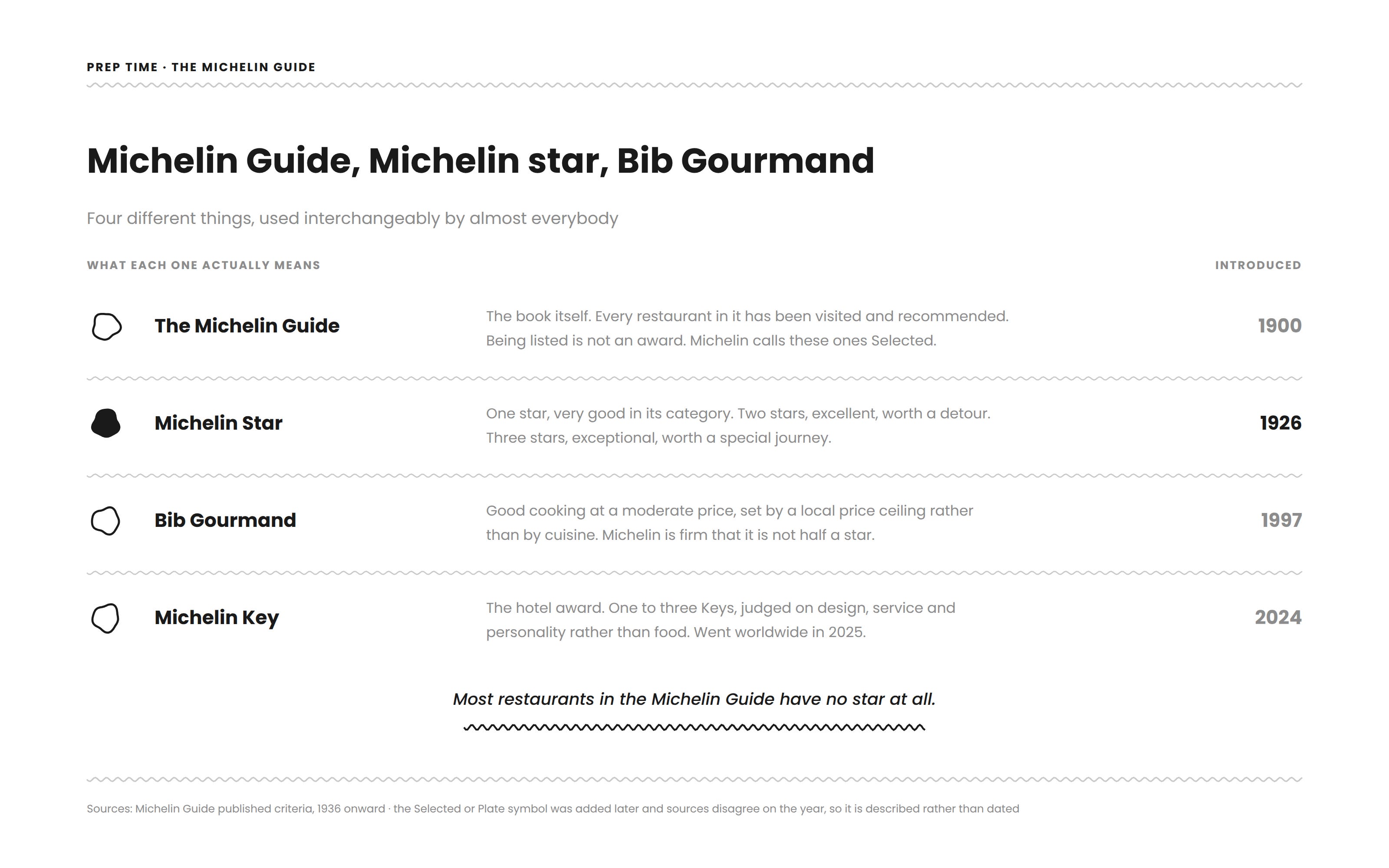
A restaurant “in the Michelin Guide” usually has no star at all. It has been visited and listed. The listing is a real endorsement and it is not the same thing as the award, and the gap between those two facts is where most of the internet’s Michelin content lives.
Do restaurants apply for Michelin stars? No, and they cannot opt out
There is no application. There is no fee. Michelin’s spokesperson Carly Grieff has stated it plainly: there is no annual fee for any restaurant or hotel to be included, and the selection process is independent. Inspectors book under false names, eat alone, pay their own bills, and file. Michelin’s international director Gwendal Poullennec says inspectors come from more than 25 nationalities and eat out up to 300 times a year. The company has never confirmed how many of them exist.
The corollary of not applying is that you cannot withdraw. In September 2017 Sébastien Bras asked to be taken out of the guide. Le Suquet in Laguiole had held three stars for 18 years, won under his father. He said he wanted to cook without asking himself whether his creations would please the inspectors. Michelin agreed for the 2018 edition, the first time it had ever done that. Then in January 2019 it put him back in at two stars, without being asked.
Michelin’s position, stated when Bras made his request, is that the guide exists for diners rather than for restaurateurs, so a restaurant has no standing in the matter. That is internally consistent. It also means the most powerful evaluator in the industry answers to nobody it evaluates. A Seoul chef, Eo Yun-gwon, tested this from the other direction in 2019, filing a criminal complaint under Korean insult law because Michelin had listed his restaurant after he refused. His phrasing was that restaurants are wasting away their soul chasing a mirage. A Korean lawyer quoted in the same reporting thought the charge unlikely to stand.
Marc Veyrat tried something narrower and lost anyway. Demoted from three stars to two in 2019, he sued for the right to see the inspection notes, asking one euro in damages. His complaint was that an inspector had apparently mistaken saffron for cheddar in a soufflé. His lawyer framed the ask carefully, saying they were not trying to forbid criticism but to check that criteria existed and had been applied. In December 2019 a court in Nanterre rejected the case on the grounds that Veyrat had not documented any loss. The court did not examine whether the criteria had been applied correctly. Most coverage read the ruling as a vindication of Michelin’s process. It was not one.
How the Michelin Guide makes money: someone pays for it to arrive
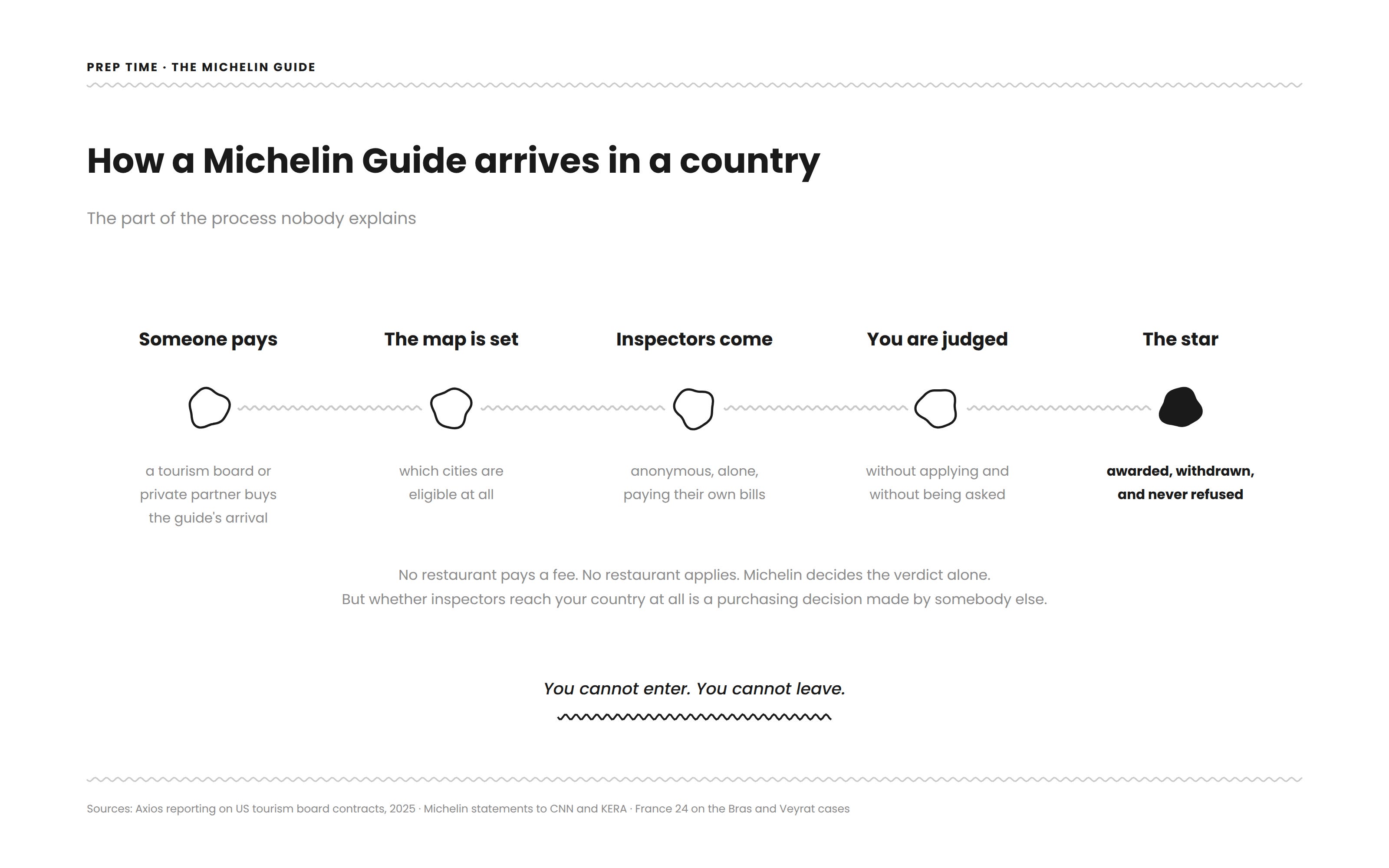
Michelin does not simply expand into a country because the cooking has become good enough. A guide arrives when a government or a private partner pays for it to arrive.
This is not a rumour. It is in tourism board budgets, and American local reporters have spent the last two years pulling the numbers out.
Texas committed $2.7 million over three years, structured as $450,000 a year from the state travel office plus $90,000 a year each from Fort Worth, Dallas, Houston, San Antonio and Austin. Fort Worth’s mayor Mattie Parker explained the logic without embarrassment: one in every three tourism dollars spent in her city goes on food and drink, more than $760 million last year, so joining was a no-brainer.
South Carolina’s share of the American South guide runs to more than $1 million over three years. The state parks and tourism department pays $100,000 a year, Explore Charleston $62,000, Visit Greenville $61,000, Visit Myrtle Beach $58,500, Experience Columbia $42,250, Visit Hilton Head $26,250. Those amounts are pro-rated by how many restaurants each destination has, so the price of being judged scales with how much there is to judge. Poullennec is on the record that the money funds communication, digital and marketing campaigns to promote the selections. The Post and Courier also reports that if the payments stop, Michelin could drop the guide.
Visit California paid a reported $600,000 in 2019. Florida put up $1.5 million, and at launch only restaurants in Miami, Orlando and Tampa were eligible for consideration, a boundary that has since widened to Pinellas, Broward and Palm Beach as the commercial footprint grew rather than because the cooking in St Petersburg changed.
And Virginia looked at the invoice and said no. Michelin quoted the state $360,000, or $120,000 a year for three years. Virginia Tourism Corp declined, citing cost and responsible stewardship of taxpayer dollars. One state government publicly refusing to buy a restaurant guide, and saying why, tells you more about the arrangement than any amount of speculation.
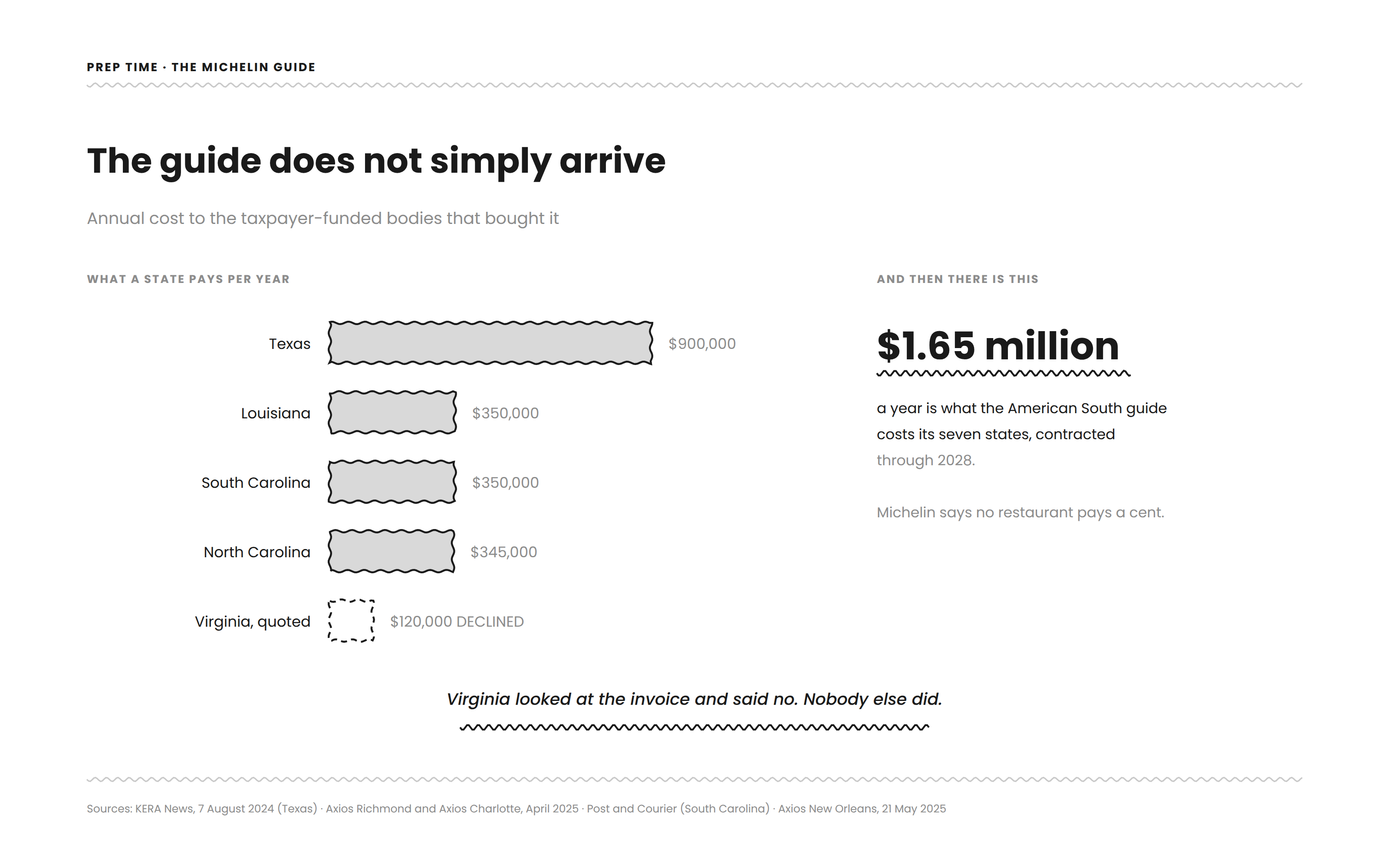
Much of this money comes from hotel occupancy taxes and, in some cities, food and beverage taxes. So in North Carolina, where five tourism bodies pay $345,000 a year between them, people staying in Charlotte hotels and eating in Charlotte restaurants are helping to fund the guide that grades Charlotte restaurants. That is not corruption. It is just worth saying out loud, because nobody involved says it.
Do restaurants pay for a Michelin star? What the money actually buys
This is the part where most commentary goes wrong in one direction or the other, so it is worth being exact.
Payment does not buy stars. There is no evidence that it does, and the people who claim otherwise are guessing. Michelin says restaurants pay nothing, and no reporting I found contradicts that.
What payment buys is arrival. It determines whether inspectors come to your country at all, and in Florida’s case it determined which cities were eligible. A restaurant in a state that did not pay is not being judged and found wanting. It is not being judged.
Then there is a third thing, documented once, that sits between the two. Reporting by Axios found that ahead of the American South guide, state tourism agencies from six states submitted lists of restaurants for Michelin’s consideration, coordinated through the regional marketing agency Travel South USA and due about six weeks before the public announcement. Travel South’s chief executive Liz Bittner told the agencies to think beyond the white tablecloth and to consider chefs already recognised by major lists or the James Beard awards, and chefs working with local agriculture and sustainable seafood.
Bittner is equally on record that the agencies had no control over the selection, that no preferential treatment or guarantees were given, and that they found out the results at the October ceremony alongside the press and the chefs.
Both of those things can be true, and I think they are. Payment does not buy a star, and it does buy the guide’s presence, the eligibility map, and at least once, an invitation to suggest where the inspectors might start looking. That is a more precise claim than “the guide can be bought”, and it has the advantage of being defensible line by line.
What the Philippines got for its money: the Manila and Cebu selection
The Philippines is the cleanest recent test. Michelin announced its arrival in February 2025 and revealed the first selectionon 30 October that year: one two-star restaurant, eight one-star, 25 Bib Gourmands, 108 restaurants in the guide altogether, across Manila and Cebu. In July 2026 the Department of Tourism confirmed it is extending the partnership to at least 2028.
Whether that moved covers, room rates or arrivals is the question every operator in the region should be asking, and the honest answer is that nobody has published it yet. The best peer-reviewed evidence comes from Spain, where Castillo-Manzano and colleagues analysed 50 Spanish regions from 2000 to 2016 in Tourism Economics and found that starred restaurants do pull foreign tourists specifically, and that quality matters more than quantity. Tourism boards cite a 2019 Ernst & Young study for the stronger version of this claim. I could not find the study itself, so treat that one as an industry assertion rather than evidence.
Do Michelin star restaurants make money?
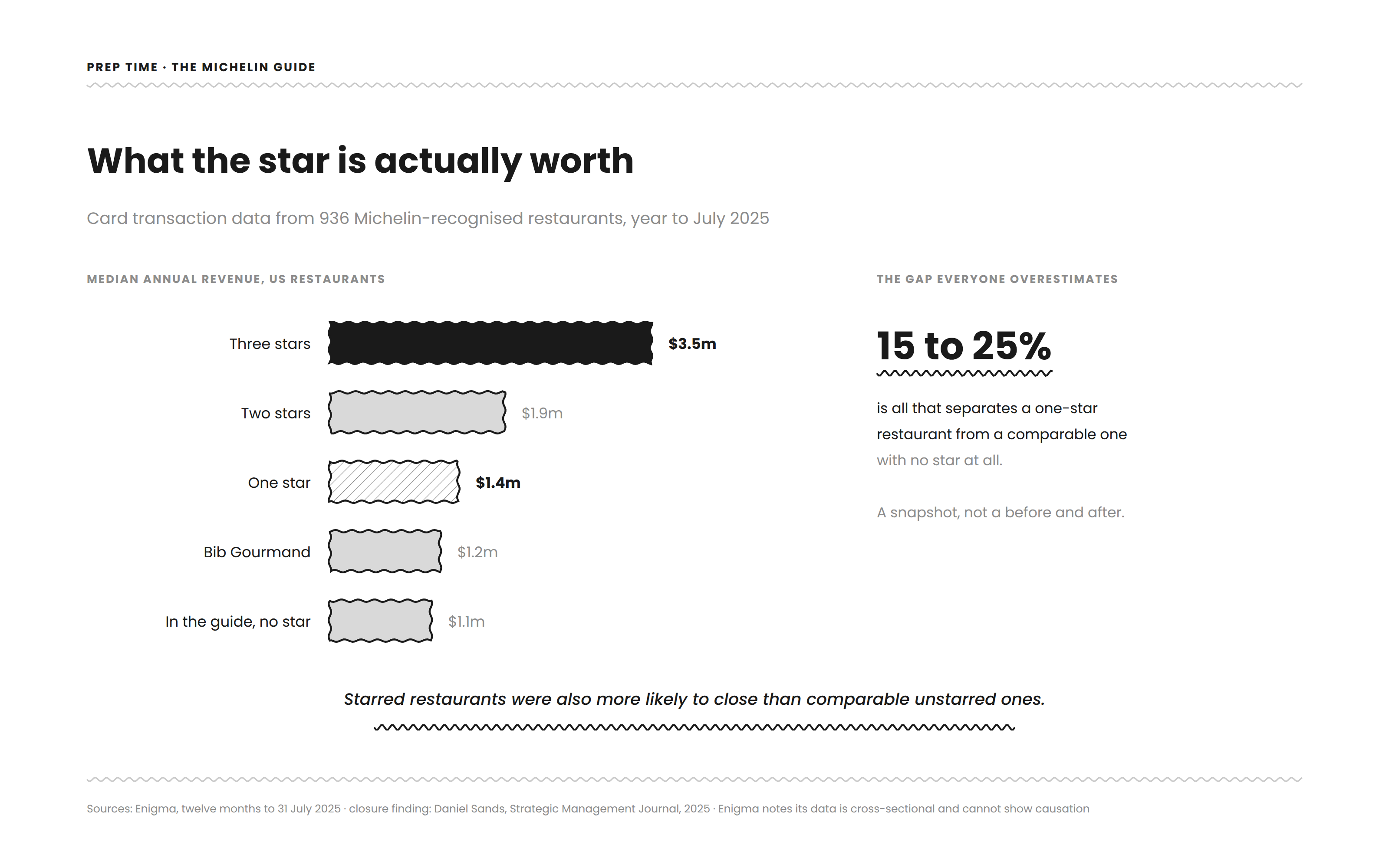
This is the question that matters if you run a restaurant rather than a tourism board, and the numbers are colder than the mythology suggests.
Enigma analysed card transaction data from 936 Michelin-recognised restaurants in the United States over the twelve months to July 2025. Median annual revenue came in at $3.5 million for three stars, $1.9 million for two, $1.4 million for one, and $1.2 million for a Bib Gourmand. The finding worth sitting with is that one-star restaurants ran only about 15 to 25 per cent above comparable restaurants with no star at all. Enigma is careful to say this is a snapshot rather than a before-and-after, so it cannot prove the star caused anything.
Prices move more than revenue does. Research using a hedonic pricing model on 486 New York restaurants, controlling for neighbourhood and cuisine, found premiums of roughly 15 per cent for one star, 55 for two and 80 for three. That is student work published on a university platform rather than a peer-reviewed paper, so treat it as an indication.
Then the finding that ought to be better known. Daniel Sands at University College London tracked New York restaurants through to 2019 and published in the Strategic Management Journal that starred restaurants were more likely to close than comparable unstarred ones. The mechanisms he identifies are unglamorous and familiar to anyone who has run a room. Landlords and suppliers reopen negotiations. Staff use the star as leverage and leave for better offers. The regulars who built the place get displaced by people who came for the accolade and will not return. Sands is careful that outcomes vary and plenty of starred restaurants do fine.
Put those three together and the shape is clear enough. The star raises what you can charge, raises what everyone expects of you, and raises your costs, and the revenue gap it opens over your unstarred neighbour is smaller than almost anyone assumes. The prize is real. It is also an obligation that arrives without a budget attached, which is why chefs occasionally hand it back.
Michelin demonstrated its own version of this in May 2026, when it retired the Green Star after six years, replacing it with a platform called Mindful Voices. More than 600 restaurants held one. Some had reorganised parts of their operation around it. A Philadelphia chef whose restaurant had won one two months earlier said the award had been flawed from the start but that a little more effort could have fixed the criteria rather than abandoning them. The precedent now exists that a Michelin distinction can simply stop.
How do Michelin stars work, and who decides them?
Five criteria, which Michelin repeats consistently in every market: quality of the ingredients, mastery of cooking and flavour, harmony of flavours, the personality of the chef expressed in the food, and consistency, both across the menu and between visits. Stars follow the restaurant rather than the chef. They can be removed. Restaurants gaining or losing one are typically visited more than once.
The inspectors are anonymous and stay that way. A hospitality manager quoted by the Irish Times earlier this year said they used to identify themselves after the meal and no longer do. Michelin will not say how many there are; industry estimates in that piece put it somewhere between 150 and 200 worldwide, which is an estimate rather than a disclosure. The oldest and best-sourced challenge to Michelin’s coverage came from a former inspector, Pascal Rémy, whose 2004 book claimed France was covered by a handful of full-time inspectors working through the country in zones. Michelin’s then-director Derek Brown disputed his numbers but conceded the underlying point, that the guide has never visited everything every year.
And no, they do not drop a fork on the floor to see what happens. That one has no source anywhere, which has not slowed it down.
Why a tyre company rates restaurants
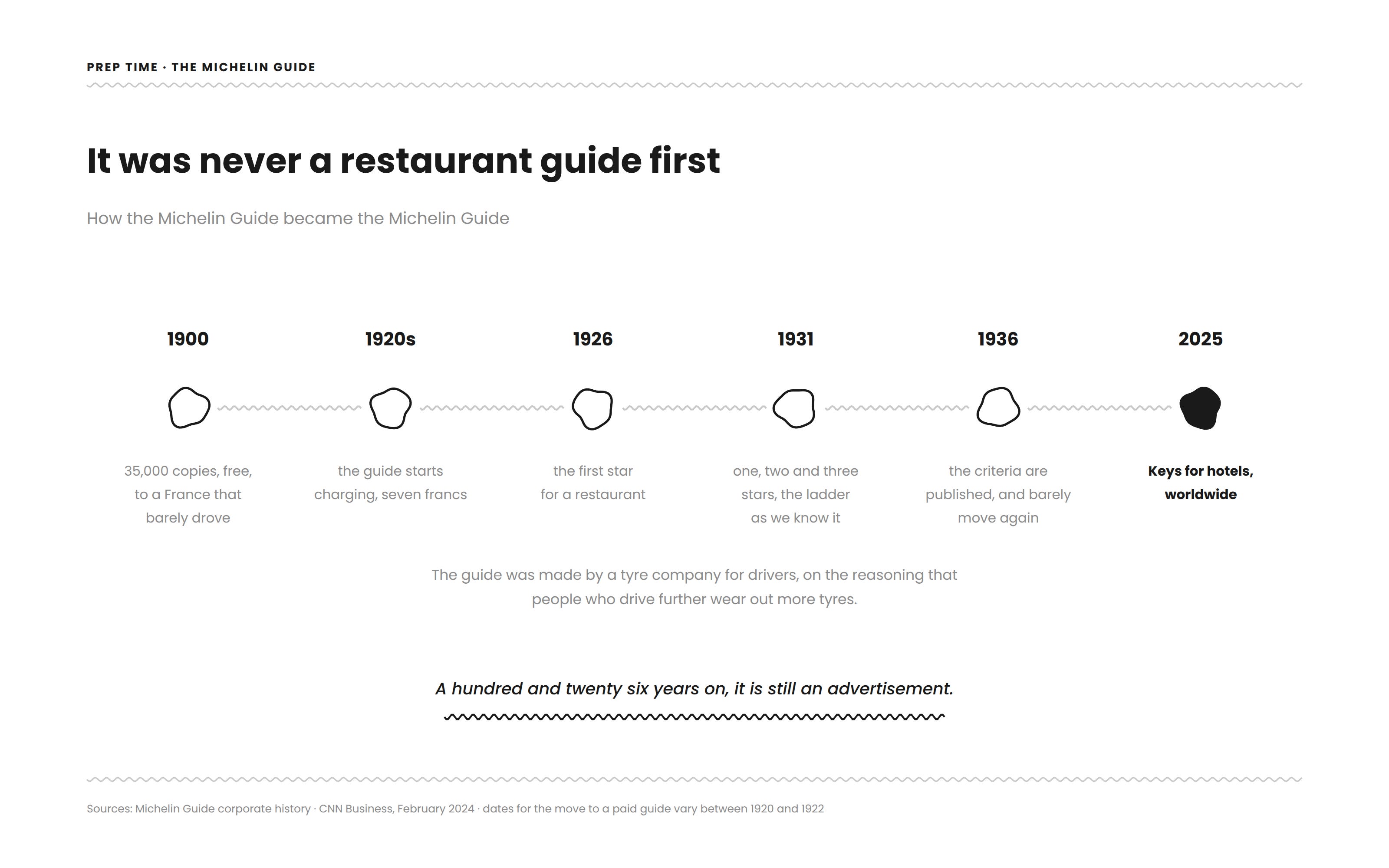
The guide began in 1900 as a tyre marketing scheme. André and Édouard Michelin gave away about 35,000 free copies to a French public that barely owned cars, listing mechanics and hotels and places to eat, on the reasoning that people who drive further wear out more tyres. Stars came in 1926. The criteria were published in 1936 and the wording has barely moved since.
The logic has not changed as much as the scale suggests. Michelin turned over €26 billion in 2025 and the guide remains a marketing asset inside a tyre company, now sold to tourism boards instead of subsidised for drivers. The customer changed. The product is the same one it always was, which is a reason to go somewhere.
That is not a scandal and it does not make the assessments dishonest. The inspectors are real, the criteria are consistent, and the restaurants that win are usually very good. But an operator deciding what to chase deserves to know that the map of where stars exist was drawn partly by cooking and partly by which tourism ministries had budget, and that the accolade at the end of it correlates with a revenue difference of 15 to 25 per cent and a higher chance of closing.
Worth wanting, probably. Worth reorganising your entire business around, that is a different question, and it is one nobody at the ceremony is going to ask on your behalf.