

A visitor asks their phone where to eat in Canggu. It names five restaurants. There are 4,776 to choose from. Ask a second AI the same question a minute later and you get a different five, with one name in common. What decides that list is not how good the food is. It is a handful of things you can fix in an afternoon, for free.
A restaurant room is full on a Friday, the reviews are good, they have their own website since two years ago, and still my friends arriving from Jakarta type the obvious question into ChatGPT and get five other restaurants recommended to them. The list that comes back takes about two seconds to make, it is made by something that has never eaten anything in the area before.
So I went and looked at what the list actually is. One day I sat in Canggu and asked four AI systems the same question a visitor would ask. “Where should I eat dinner in Canggu? Give me specific restaurants.” Same wording every time.
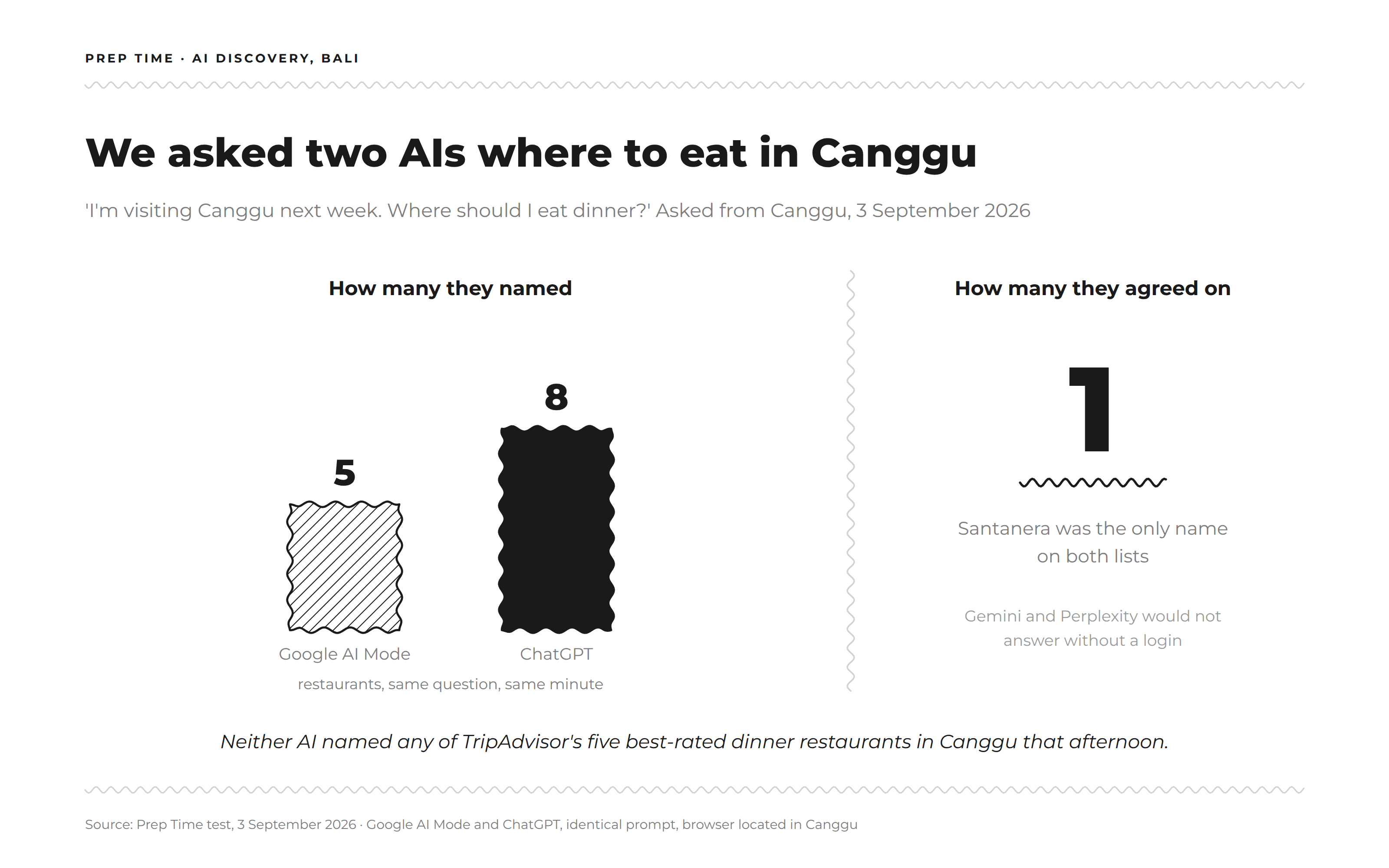
Google’s AI Mode answered in Indonesian, because of where the laptop was standing, and sorted five restaurants by occasion. Luma and Santanera for a date, Penny Lane and 12 Kitchen and Wine for a dinner that turns into a different kind of night, Dolan for something calmer. All five had a website. Every citation at the foot of the answer said the same word, Google, which means Google’s AI was reading Google’s own business listings rather than the web.
ChatGPT gave me eight and cited two travel listicles, The Urban List and Honeycombers. Santanera again, then Sa’Mesa, SIA, Ulekan Berawa, Lulu Bistrot, Hippie Fish, Warung Sika, Cantina Classe.
Gemini and Perplexity would not answer without a login, so I have two answers rather than four.
Santanera is the only name on both lists.
Plain Google search for the identical question produced a third Canggu. Ten results and not one of them was a restaurant. Travel blogs, TripAdvisor, a guide last updated in 2022, all of them people writing about restaurants rather than the restaurants themselves. The same company, in the same session, was running two different answers to the same question and they did not overlap.
Then I opened TripAdvisor’s best dinner restaurants in Canggu that afternoon. Top was Eskqbar at 4.9 from 481 reviews, third of 590 restaurants, with its own website. Then Taru at a flat 5.0, the dining room at Regent Bali Canggu, a five star hotel with a booking engine and a marketing department behind it. Then Ketela Eatery at 4.9 from 747 reviews, then Vore, then Seabird.
Neither AI named any of them.
Why is my restaurant not showing up on Google? Because it has not been written down enough
Not because it is not good enough. Rating is not the filter and it is not close to being the filter.
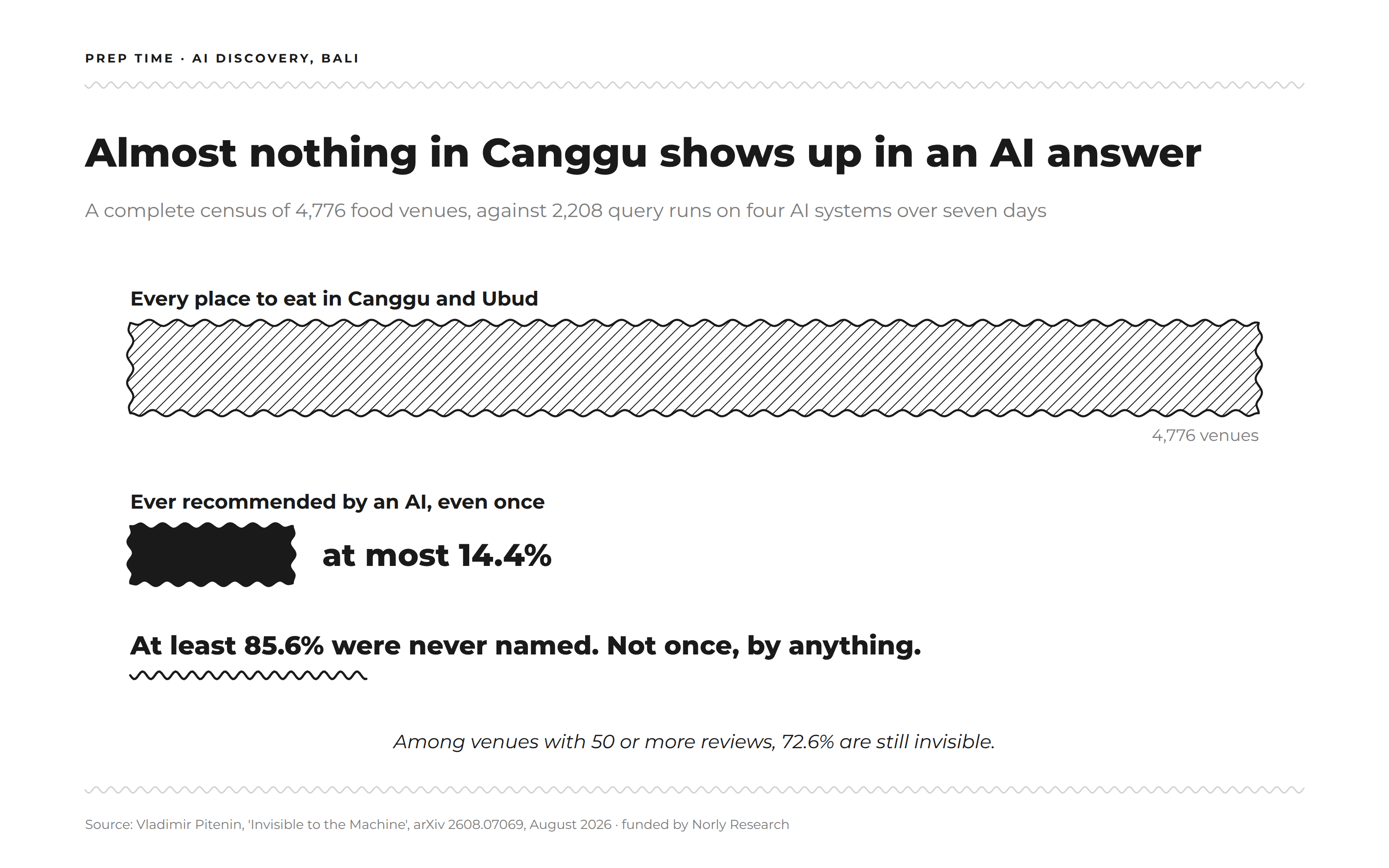
In August 2026 a researcher named Vladimir Pitenin published Invisible to the Machine, the first study of this that used a complete market rather than a sample, and the market it used was ours. He enumerated every food business in Greater Canggu and Greater Ubud, 4,776 of them, warungs and bakeries included, then put 2,208 questions to ChatGPT, Claude, Gemini and Perplexity across eight traveller personas and counted every venue any of them named.
At least 85.6% were never named by anything, in any run. Not rarely. Never. The obvious objection is that the missing ones must be the tiny places nobody has heard of, so take only the venues carrying 50 or more reviews, which is a real business with real customers, and 72.6% of those are still invisible.
The useful finding sits underneath that one. Showing up at all and ranking well once you are there are two different problems, and they answer to different things. Once you see that, most of the advice being sold to restaurants falls apart. Having your own website nearly doubled the odds of appearing at all. After that came how many people had reviewed you, then whether your prices were listed, then whether other sites mentioned you. Star rating, the number every operator watches, came in at 0.89, which is no effect at all. It only starts to matter once you are already in the answer, at which point it decides where you sit in it.
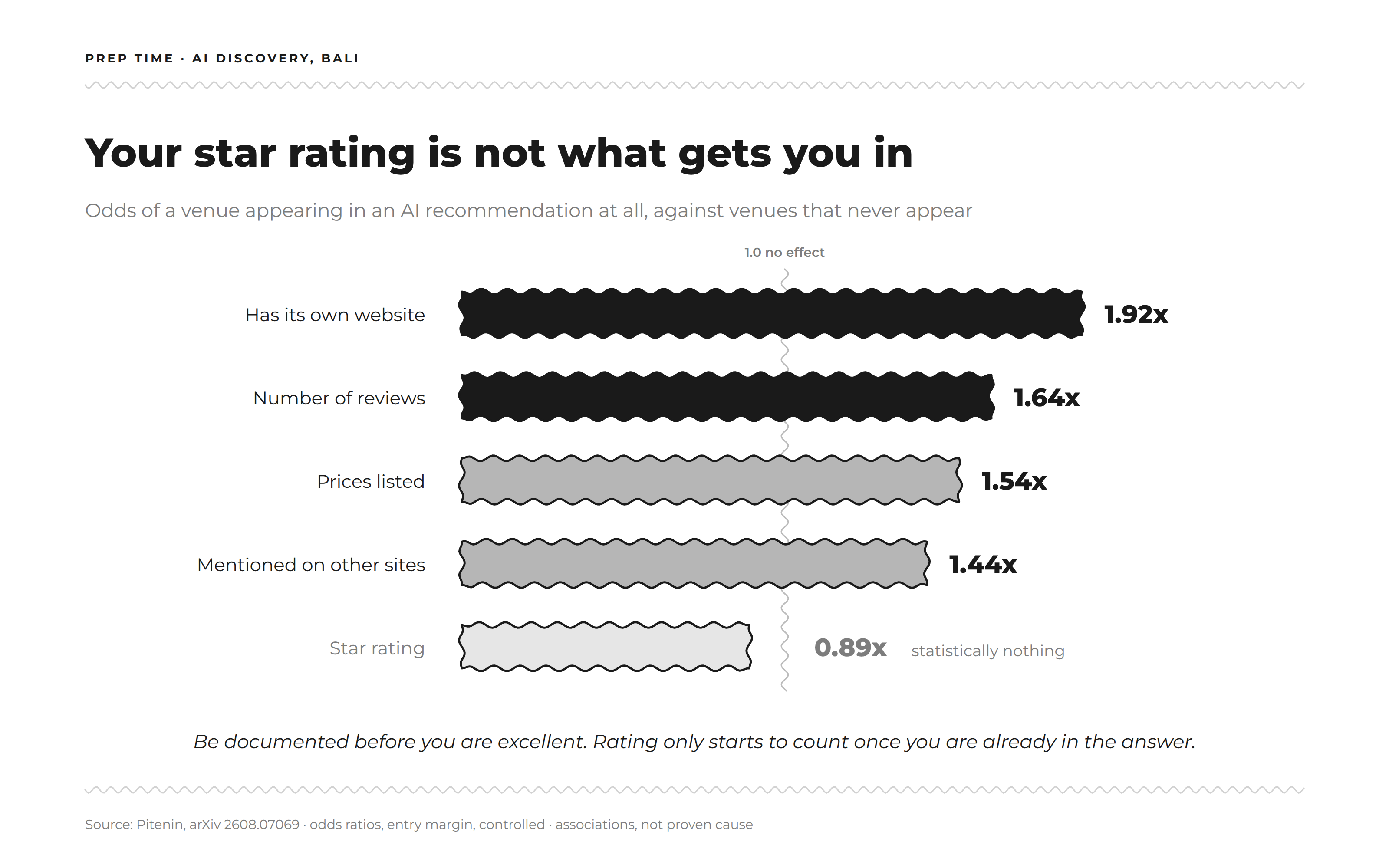
Pitenin’s own summary of it is the line to keep. Be documented before you are excellent. A 4.9 café with thin documentation is, to these systems, indistinguishable from a café that does not exist.
The study is observational, so these are associations under controls rather than proof of cause, it ran in English over seven days in one region, and it was funded by Norly, which sells hospitality marketing tools and says so in the paper. I am telling you that because almost nobody else in this conversation tells you who paid.
One more number from it. The systems recommended 14 permanently closed venues, 93 times. Only 0.08% of all mentions looked like invention, so the machines are not making restaurants up. They are reading a map that is out of date, confidently, to somebody who then drives there.
Why is my restaurant not showing up on Google Maps? Distance, and a profile you never finished
Maps runs on different rules from an AI answer and the two get treated as one thing constantly.
Google says openly, in English and in Indonesian, that local results come down to relevansi, jarak, keterlihatan. Relevance, distance, prominence. Distance you cannot do anything about. Prominence is how well known you are, which Google ties to links and review count. Relevance is whether you filled the profile in, and Google’s own line on that is blunt: bisnis dengan info yang lengkap dan akurat lebih berpotensi muncul di hasil penelusuran lokal. The same page also says you cannot ask or pay for a better local ranking, which is worth remembering the next time somebody offers to sell you one.
You can watch the two systems disagree. The map pack in my search put up Penny Lane, Ketela Eatery and Alchemy, all three well reviewed and all three inside walking distance of the laptop. Google’s AI, running in the same second, kept Penny Lane and replaced the other two with restaurants further away. So a restaurant can own the map for everyone standing near it and never be mentioned to the person deciding from Sydney where to eat on Thursday. Those are two different customers and they are won differently.
How to rank in AI search: the fixes, in the order the evidence supports
Nine things, none of which cost money. The first four are your own website, which the audit found matters more than anything else. The rest is your Google profile and your reviews.
1. Get a website you own. Not an Instagram account, an actual website, even a single page. It was the strongest single predictor of appearing at all, and it is the only description of your restaurant that you control. Warung Sika is the honest exception, named by ChatGPT with no website I can find, only an Instagram and a lot of other people writing about it.
2. Put the menu on it as text. Not a PDF, not a photograph of a chalkboard. Google’s structured data documentation asks for the menu as a proper URL, and nothing reading your site can see inside a JPEG, so if your dishes live only in an image they do not exist. This is the most common failure I see on restaurant sites here and it is almost always a design decision nobody went back to.
3. Put your prices on it. Another of the top predictors, costs nothing, and it happens to be what people are actually asking, since a good share of these questions carry a budget inside them.
4. Mark the page up. LocalBusiness structured data requires two fields, name and address, and everything else is optional. The optional list reads almost exactly like the audit’s findings: URL, phone, coordinates, opening hours, price range, cuisine, menu. That is twenty minutes of work for whoever built your site, and anyone quoting you a project rate for it is charging you for twenty minutes.
5. Ask everybody for a review, and reply to them. Review volume was the second strongest predictor after a website, and score was not, which means 100 reviews at 4.4 is a stronger position than 15 at 5.0 and the average you have been protecting is not the number doing the work. Google allows asking by link or QR code and strictly prohibits offering anything in exchange, naming free or discounted food directly, so the dessert-for-five-stars arrangement is the thing the policy was written about rather than a grey area. Reply to them as well, partly because Google asks businesses to answer the ones where they can say something useful, and partly because every reply is another sentence of text about your restaurant on a page these systems read constantly.
6. Finish your Google profile. Completely. It is the one thing Google states outright affects whether you appear, and most profiles I open are about 60% done.
7. Fix your categories. Few and specific, following Google’s own guidance to pick the ones that finish the sentence “this business is a” rather than “this business has a”, which means a restaurant with a bar is not a bar.
8. Keep your hours honest, including the days you close. Nyepi shuts the island and Galungan moves every year. A locked door on an open profile earns you a review from somebody standing outside in the heat that will outlive the holiday by years.
9. Spell yourself the same way everywhere. One name, one address format, one phone number. These systems have to work out that the warung on Instagram and the warung on TripAdvisor are the same restaurant, and there is no reason to make that hard.
Two things not to spend money on. The audit tested Foursquare presence and found nothing at either margin, which is worth knowing because directory bundles are still sold here on the promise that more listings means more visibility. And be careful with anyone selling ChatGPT optimisation specifically, since ChatGPT’s share of AI traffic fell from 76% to 53% in a year while Gemini climbed past 27%, which is a faster moving target than any retainer.
Who is paying for the numbers you are reading
Almost every statistic in this field is published by a company that sells the fix, mine included at one remove.
The 83% figure you will see everywhere comes from Uberall’s May report on quick service chains, and Uberall sells location marketing. Yext, whose citation research everyone quotes, sells listings management. None of that makes the numbers false. It does mean noticing who is holding the clipboard, particularly when the same report ends with a 90 day plan and a URL. It also means the two datasets can contradict each other in public without anyone minding, which they do. Uberall reports rating floors of roughly 4.3 for ChatGPT and 3.9 for Gemini, while Pitenin found rating does nothing at entry. Both could be true if well documented restaurants also tend to be well rated, and I do not know which reading is right.
You also cannot check your own fix by asking once. Miriam Ellis at Whitespark tested Google’s AI Mode in May and found that two people asking the identical question from the identical place get different answers, because the system fans one question out into several behind the scenes. Give it weeks and judge it on covers.
And there is a hole in the middle of the whole subject. DoorDash’s March survey of 3,001 consumers found 22% have used an AI tool to choose a restaurant, and BrightLocal puts the broader figure at 45% asking AI for local recommendations, up from 6% a year earlier. Nobody has published a figure connecting an appearance in an AI answer to an actual booking. Everyone measures visibility because visibility is easy to measure.
BrightLocal did find one thing that cuts against the panic. 88% of people who use AI this way check what it told them and 42% always cross reference against real reviews before going anywhere, so the line about there being no second page is only half right. There is no second page but there is a second step, which makes the review section you have been ignoring the second gate rather than the first.
What this is worth
The short version is that your restaurant is probably not missing because the food is not good enough. It is missing because not enough has been written about it in the places these systems read. So open your own website tonight and check three things: that the menu is text and not a picture, that the prices are on it, and that your Google profile is finished rather than mostly finished. That is one afternoon, it costs nothing, and it closes most of the gap between being good and being found.
If you run a restaurant in Bali and you have worked on these things and watched something change, I would love to hear your thoughts on this.
Frequently Asked Questions
Why is my restaurant not showing up on Google?
Usually because it hasn’t been documented enough, not because it isn’t good. Research across nearly 4,776 Canggu and Ubud venues found that having your own website, a high review count, and listed prices predict whether you appear, while star rating had almost no effect on getting into a result at all.
Why is my restaurant not showing up on Google Maps?
Google Maps ranks local results on three things: relevance, distance and prominence. Distance you can’t change, but relevance depends on how completely you’ve filled in your Google Business Profile, and Google states outright that businesses with complete, accurate information are more likely to appear.
How do I get my restaurant recommended by AI like ChatGPT?
Start with a website you own, since it was the single strongest predictor of appearing in AI answers. Then put your menu and prices on that page as real text rather than a PDF or photo, add LocalBusiness structured data, and build up your review count. Documentation matters more than a high rating.
Does my star rating affect whether AI recommends my restaurant?
Not for getting into the answer in the first place. A study found rating had essentially no effect on whether a venue appeared at all. Rating only starts to matter once you’re already in the result, where it helps decide your position, so review volume beats a protected average.
Should I pay for directory listings or ChatGPT optimisation services?
Be cautious. The same research found Foursquare presence made no measurable difference, and ChatGPT’s share of AI search fell from 76% to 53% in a year while Gemini rose, so optimising for one tool is a fast-moving target. Most of what works, a website, a complete profile, menu text, reviews, costs nothing.