

Free meals and free villa nights get traded in Bali WhatsApp groups every day, and there’s now an app that screens your Instagram before it lets you in. Then I found out three separate authorities already count that as income, while the restaurant handing it over books it as food cost, which is a much smaller number. Somewhere in that gap is an industry nobody has priced.
I’ve been living in Bali almost a year now and there’s this thing I keep noticing and can’t stop thinking about. The influencer economy. Maybe it’s not even new, but living here you cannot miss it.
Restaurants and cafes inviting influencers in to eat. Hotels and villas inviting them to stay. Sometimes there’s money involved. A lot of the time there isn’t. It’s a free meal, a free night, a spa treatment, a table at a beach club, in exchange for a story or a post or a shout out.
And then I started noticing where it actually happens, which is not anywhere fancy. It’s WhatsApp groups. Facebook groups. Someone posts that a place is looking for creators this week, here’s what they’ll give you, here’s what they want back, DM to apply. No agency, no media plan, no contract. A group chat.
Which made me want to know, and this is the whole reason for this piece. Is that paying?
The Secret Society: the Bali app that screens your Instagram for free meals
The group chats are the loose version of this. Then I found the app, which is the same trade with a bouncer on it, and the whole thing stopped being vague.
It’s called The Secret Society. You sign up with your Instagram, and their team goes through your profile, your audience, your engagement, the kind of content you post, and they decide whether you’re in. You need an active account and three photos of yourself. That’s the whole entry requirement. If you’re accepted you get a feed of things you can apply for, and if the venue picks you, you get a QR code to show at the door.
What’s behind the QR code is not small. Restaurants from casual to fine dining. VIP tables at clubs. Beach clubs, pool clubs, gyms, spas, wellness lounges, clinics, salons, day trips, villa stays, brunches, sunset cocktails. And a plus one, frequently.
What you owe in return depends on the listing. Some want a reel. Some want stories. And some, I love this detail, just want you to be present to create a vibe at an event. That’s a real deliverable, written into a real marketplace. Turn up and be the kind of person who makes a room look full.
Both sides get rated afterwards. The venue scores you on whether you delivered. So there’s a reputation ledger running underneath it, which is the part that makes it a market rather than a favour.
It launched in Bali in mid 2024 and it was never a Bali idea. It came from Dubai in 2017, and the founder’s story is the actual reason I ended up writing this whole thing.
Who built The Secret Society (and why it’s really a promoter app)
Romain Fourel was a general manager at Abercrombie & Fitch in Dubai for six years, and while he was there he started modelling and doing social shoots for restaurants and bars. Which meant that venues started calling him. Not to book him. To ask him to bring people.
He told SEELE magazine it directly. “Restaurants, nightclubs, and beach clubs often asked me to bring Abercrombie models to their venues. That’s when I realized the appetite for these types of connections.”
Before the app existed, he was doing the job on WhatsApp. Not making money from it. Just connecting people, because people kept asking him where to go tonight.
And then this line, which I keep coming back to, about why he built the thing. “The landscape was filled with go-to solutions like promoters, while the social media space was evolving rapidly, but the tools weren’t keeping up.”
Read that again. He is not describing a new industry. He is describing the promoter job, the oldest job in nightlife, running on worse software. The whole app is that job with a rating system bolted on.
He self funded it, worked three years of multiple jobs to save for it, and his wife eventually told him to do it or stop talking about it. As of last year he’s got a team of 60, a thousand venues, and 100,000 members, across Dubai, London, Bali and Riyadh, launching in a new city every sixty days. Riyadh alone hit 4,000 members within about three months of opening.
He also said something about the psychology that I think is the most honest sentence anyone in this industry has said out loud. “I’ve always been fascinated by how hype works. It’s a psychological effect, a group dynamic. Hype needs to feel genuine, though. If it looks fake, it dies.”
So: a marketplace whose product is a feeling that must not look like a marketplace.
Is a free meal taxable in Indonesia? PMK 66/2023 already said yes
This was my actual question, the one that started all of it. And it turns out it is not a grey area at all, which surprised me, because everyone talks about it like it is.
Indonesia settled this in 2023. PMK 66/2023, the finance ministry regulation that came into force on 1 July that year, deals with two words worth learning. Natura, meaning goods whose ownership transfers to you. And kenikmatan, meaning the right to use a facility or a service. Both, when received in connection with work or services, are objects of income tax.
A gifted product is natura. A comped dinner is kenikmatan. A free villa night is kenikmatan. The regulation lists what’s exempt, things like food provided to all employees, benefits in designated remote areas, equipment you need to do the job, and a tasting menu in exchange for a reel is none of those. Tax practitioners in Jakarta have been saying this applies to influencers specifically since it landed, and the tax office reportedly runs a social media monitoring system called SONETA, though I could not find the founding document for that one and I’m not going to pretend I did.
The US arrived at the same answer from the other direction. Comped experiences and gifted products given in exchange for a post are barter income, taxable at fair market value, and brands have increasingly been issuing 1099-NEC forms for the value of what they sent, with the product value sitting in the same box as cash would.
And since April this year Indonesian immigration has taken the strictest line of the three, treating unpaid content deals in Bali as commercial activity requiring a work visa regardless of whether money moved. That’s a whole separate article and I’m not writing it today.
Three authorities. None of them coordinating. All of them landing on the same conclusion, which is that the free dinner is a payment.
The only people still calling it a gift are the people doing it.
What a comped meal actually costs a restaurant
Here’s where I got properly interested, because the two sides of this are not even valuing the same object at the same price.
Say the dinner is a million rupiah. Full service restaurants run a food cost of roughly 28 to 35 percent, so call it 30. The venue’s actual cash outlay on that meal is around three hundred thousand.
But the tax law values what you received at fair market value. Which is the menu price. A million.
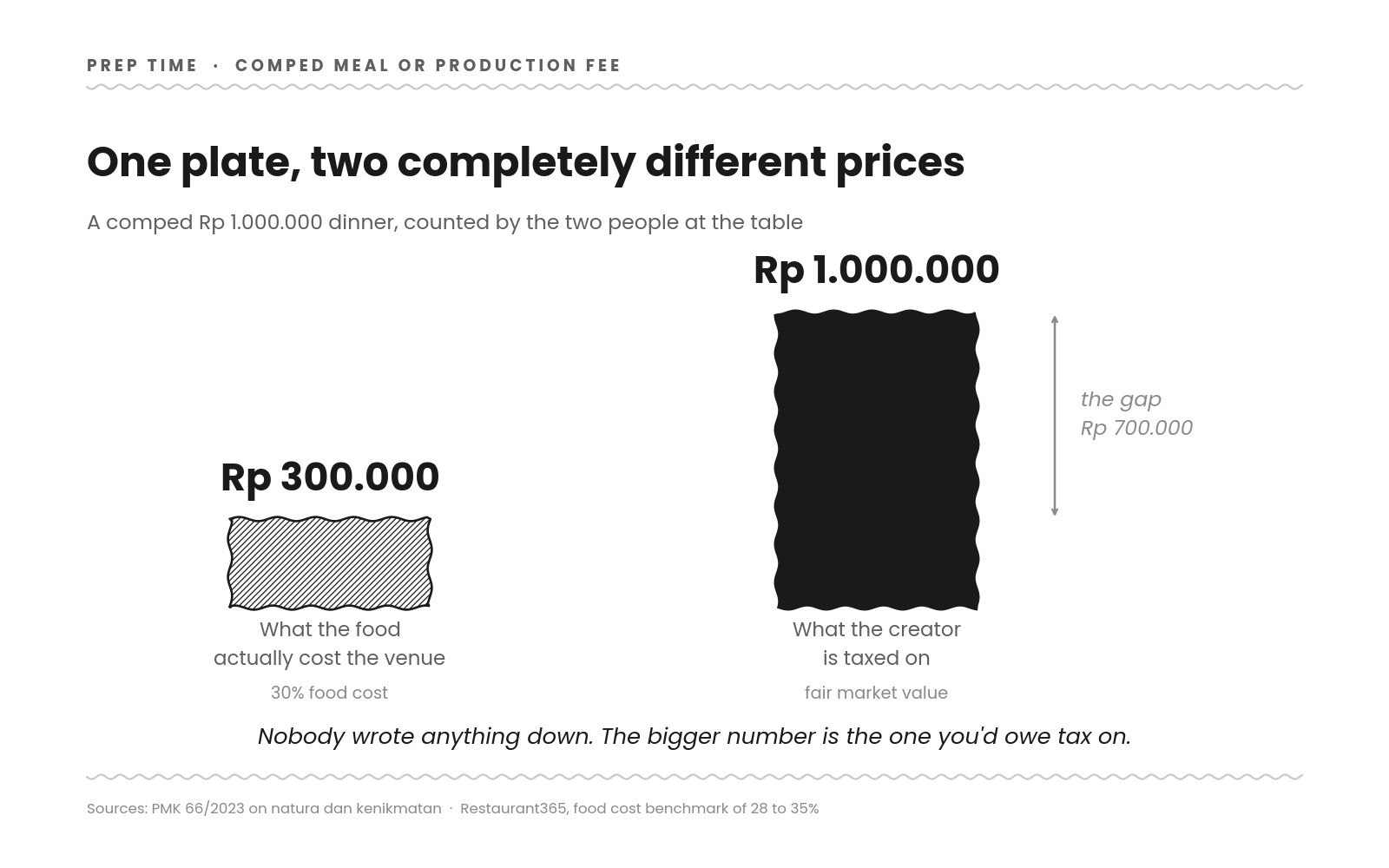
I find this genuinely funny in a bleak way. The restaurant is thinking in cost. The creator is thinking in value. The tax office is thinking in menu price. Nobody wrote anything down. And the venue is booking it under food cost, alongside wastage and staff meals, rather than under marketing, which means the thing is invisible in the one line of the P&L where you’d actually go looking for it.
Now the second number, which is the one I’d want if I owned a restaurant.
Full service places run a net margin of about 5 to 10 percent, with prime cost eating 55 to 65 percent of revenue. Take 7 percent as a fair middle. To generate three hundred thousand rupiah of actual profit at 7 percent, you need to sell about four and a quarter million rupiah of food.
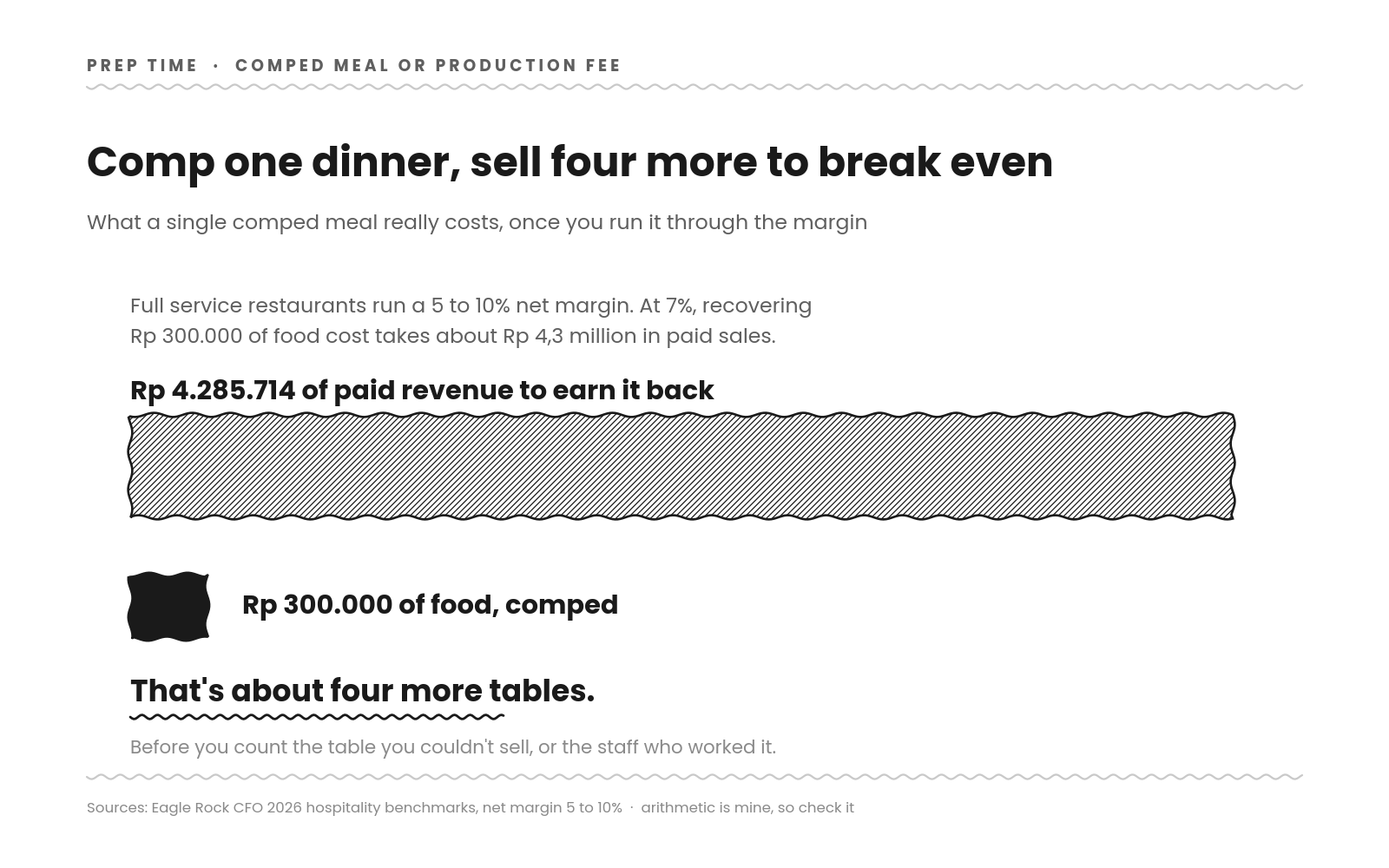
One comped dinner costs you about four paid ones, in profit terms. And that’s the generous version, because I’ve only counted the food. Not the table you couldn’t sell. Not the server, the kitchen, the host who managed the booking. Not the hour.
Against that, the benchmark marketing budget for an established restaurant is 3 to 6 percent of revenue. So the question isn’t really whether comping is ethical. It’s whether anyone is counting it against that 3 to 6 percent at all, and from everything I can tell, mostly they aren’t, because it’s hiding in food cost.
If you own a venue and you’ve comped fifteen covers this month, you have spent real marketing money and it is not in your marketing line.
Bali run clubs, club promoters, and who gets paid in cash instead of food
So back to the dinners, because this is the part that actually rearranged how I think about it.
Nightlife has been paying people to bring people for decades and has never once been coy about it. The rates are public and boring. Promoters get somewhere around five to twenty dollars a head depending on the venue and the night. Bottle service typically commissions at 10 to 20 percent of the table spend. Head promoters on a percentage deal can sit at 20 to 35 percent of everything the bar takes. There are sub promoters underneath them on five to ten a head. It’s a tiered commission structure, written down, argued over, paid in money.
Same job. Bring bodies through a door on a night the venue needs bodies. The nightclub version gets a cheque. The hospitality version gets a plate.
And it isn’t just me and it isn’t just apps. The community layer here is enormous now. Bali’s run clubs have gone from a niche expat thing to a real network of clubs partnering with cafés and wellness brands, whole business models built on a morning run that ends at a coffee shop. Entourage, started by two Dutch founders, ran more than 250 events in its first year and grew WhatsApp groups past 4,000 people, runs and padel and surf, hosted at local venues.
Every one of those events is footfall delivered to a business at a specific hour. Every single one is a promoter deal. Almost none of them are called that, and I’d guess very few are invoiced.
Forbes called this the third space boom and framed it as everyone from wellness to hospitality competing on who can make a stranger feel like they belong by the end of the night. Which is lovely, and also, belonging is now a media buy with a rate card that nobody has printed.
Influencer marketing in Indonesia: the market size nobody is counting
Right. The opportunity, which is what I actually wanted to get to.
Start with the honest admission that this industry cannot measure itself. Global influencer marketing forecasts for 2026 run from about 34.1 billion dollars at the low end to 47.8 at the high end, with Mordor landing at 40.51 in between. That is nearly fourteen billion dollars of disagreement about the size of a thing.
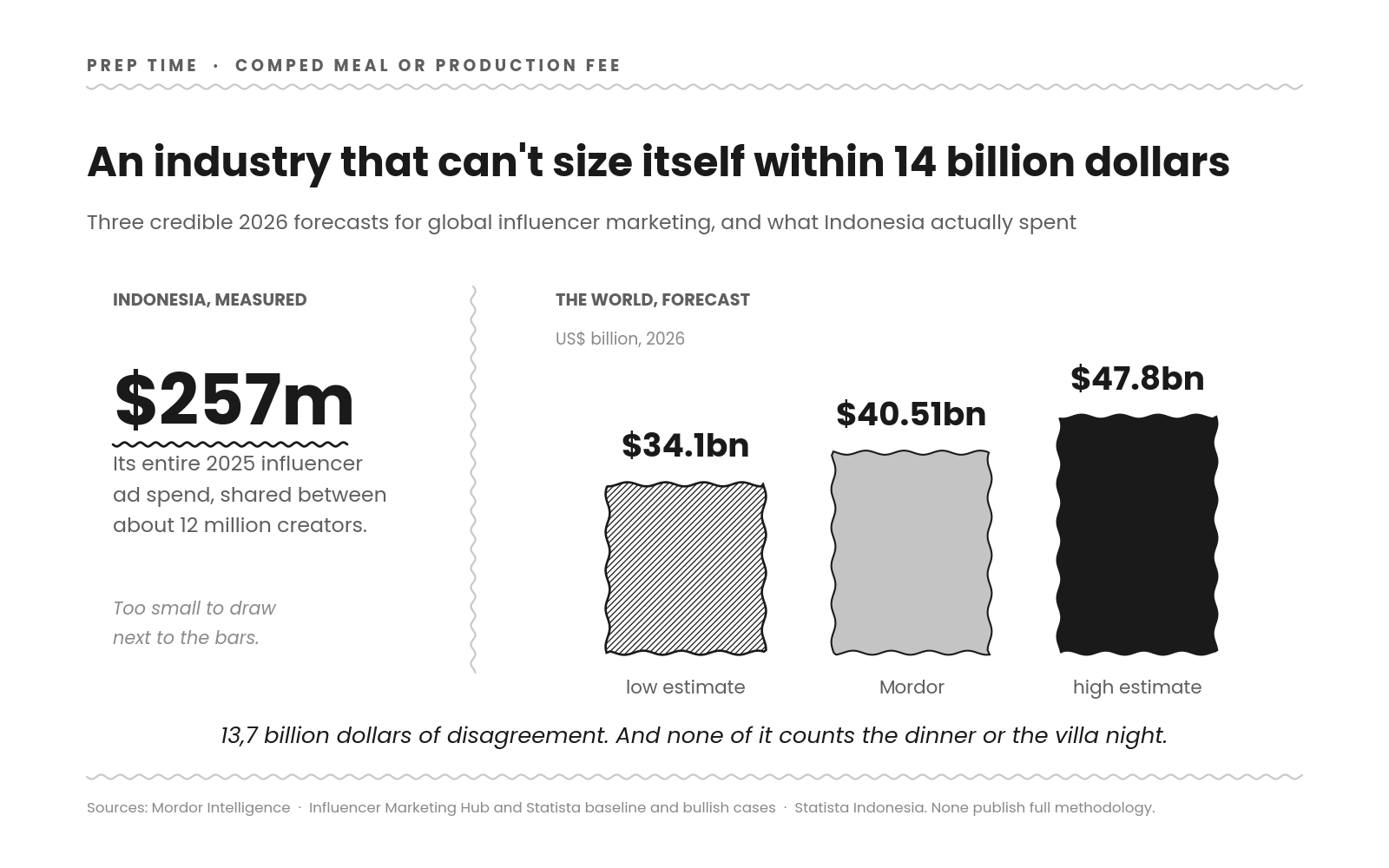
Indonesia’s own number is about 257 million dollars in 2025, up from 225 the year before, growing near 10 percent a year. Which sounds modest until you put it next to the participation. GroupM counted around 12 million Indonesian creators producing something like a million pieces of content a month against roughly 143 million social users. One of the highest creator to population ratios anywhere.
Twelve million creators. Two hundred and fifty seven million dollars. That’s about twenty one dollars per creator per year in measured spend.
Obviously that can’t be the whole picture. And the reason it can’t is the reason I’m writing this. The measured number counts cash. It does not count the dinner, the villa night, the beach club table, the QR code at the door, the discount I negotiated for my group. None of that is in anyone’s market size, because none of it moves through a payment rail.
The barter layer is not a small edge case sitting next to the real market. In a place like Bali it might be most of the market.
So the openings, as I see them, and I’d love to be argued with on all of these.
The boring one, which is usually the right one. Somebody should sell venues a way to see this spend. Not a creator marketplace, there are plenty. A tool that pulls comps out of food cost and puts them in the marketing line with a cost per cover attached. Every restaurant I’ve ever talked to about this has a feeling about whether it works and not one has a number. Traceability is unglamorous and it’s the difference between a budget line you can defend and a habit you can’t.
The pricing one. There’s no rate card for any of this in Southeast Asia. Global guides will tell you a hotel creator collab runs three hundred dollars at a small boutique up to three thousand at a property with a formal programme, with raw footage licensing on top at plus 30 to 50 percent. None of that translates to Canggu and everyone here is negotiating blind. Whoever publishes the first credible Bali rate card sets the market, which is a genuinely powerful position.
The one that’s already happening. The industry is drifting from gifting toward paid plus licensing, because brands worked out that the valuable thing was never the influencer’s audience, it was the footage. You can buy a reel once, or you can buy the B roll and cut it into campaigns for a year. That reframes the creator as a production company that happens to have followers, which is a much better business for them and a much clearer invoice for everyone else. It also makes “production fee” an honest description instead of a euphemism.
The one nobody’s built. The community layer has no infrastructure at all. Run clubs, dinner groups, padel WhatsApps, the whole footfall economy, all of it operating on goodwill and vibes with no contracts and no rates. Nightlife solved this decades ago with a commission structure. Hospitality hasn’t, and the people doing the work, me included, are mostly taking payment in a form they can’t bank, can’t report, and can’t build on.
And there’s a real risk in all of it, which is Fourel’s own line. Hype needs to feel genuine, and if it looks fake it dies. Every one of these fixes makes the thing more formal. More formal means more visible. More visible means the audience can see the machinery, and the research on disclosure is genuinely split on what that does. Broadly, telling people it’s sponsored costs you engagement in the short term and buys you credibility over time, and it hurts big accounts more than small ones. So the people with the most to lose from honesty are the people at the top, which explains a lot about who’s arguing for what.
So, comped meal or production fee?
I’m still going to message the next venue and ask for a discount. Let’s be so for real. But I’ve stopped thinking of it as a favour, and I’ve started thinking about what it’s actually worth to them, which is a table of confirmed people on a night they’d otherwise be quiet, and what it costs them, which is more than they think and less than I’d have guessed.
The thing I can’t stop turning over is that we built an entire economy on the one form of payment that leaves no trace. Not because anyone was hiding anything. Because dinner didn’t feel like money.
So my question for you, and I actually want to hear it. If you run a venue, do you know what you spent on comps last month? Not roughly. The number. And if you’re on my side of it, bringing the people, what would it take for you to send an invoice instead of a thank you?
Thanks for reading Prep Time. If you’ve negotiated one of these deals from either side, tell me what it looked like. I’m collecting them.