

There’s a restaurant in Pererenan where the staff wear the ingredient list on their chest, and it worked on me, and it has worked on a lot of people. So I went looking for where that fat actually comes from, and found out Indonesia already had this exact argument in the 1980s, about a completely different oil, and quietly lost it.
Writing this from Bali, where I have now walked past three gyms in about four minutes, which is not an exaggeration and is not even unusual anymore.
You know what I mean if you live here. There’s a gym every 300 metres. Then a mega gym. Then a wellness club with cold plunge and infrared and a juice counter. There are running clubs, there are walking clubs, there was that whole drama a while back that I’m not going to relitigate here. The whole island has quietly turned into a place where your workout is a social calendar.
So it makes sense that the food followed.
Why Bali restaurants are putting "no seed oil" on their staff t-shirts
I ate at Butter Protein Club when it first opened.
What I remember most isn’t a dish. It’s the staff. They were wearing crew shirts that basically said it out loud, no seed oil, we only fry in beef tallow. The ingredient list, on a t-shirt, walking around the room before you’ve even ordered.
And their whole pitch was carnivore diet but make it healthy, and make it not cost a fortune, which in Bali is genuinely a position. They were popular from the very beginning and I don’t think that’s a coincidence. The shirt WAS the marketing.
They’re still running that way. Butter Protein Club describes itself as an animal-based, seed oil free fitness steakhouse, fried things in beef tallow, stir fries in grass fed butter or olive oil, salads in extra virgin olive, vegan dishes in coconut oil. The Meat Emporium over in Kerobokan does tallow fries too. There is now an entire directory of seed oil free restaurants with a Bali section, which is a sentence I could not have written five years ago.
So I got curious. Is this a real shift, or is it a t-shirt? And if it’s real, where is all that beef fat coming from?
The answer to the second one turned out to be the interesting part.
Why McDonald’s stopped frying in beef tallow in 1990, and why the fix was worse
Quick history, because it’s short and it’s genuinely a bit unhinged.
Until 1990, McDonald’s fried in beef tallow. Then it stopped. The company announced the switch to vegetable oil in July 1990 after eight years of internal study, cutting saturated fat per serving by about 45 percent.
A big reason it happened is one guy. Phil Sokolof, an Omaha businessman who had a heart attack at 43, started the National Heart Savers Association and bought full page newspaper ads in New York and Chicago going directly at McDonald’s over the tallow. He’s reported to have spent around 15 million dollars campaigning over two decades, though I’ll be honest, that figure travels around the food press and I couldn’t chase it back to a primary document, so hold it loosely.
Here’s the part that makes me laugh in a not funny way. The vegetable oils that replaced the tallow were partially hydrogenated. Which means trans fats, which the FDA later moved to eliminate entirely, forcing the entire industry to reformulate a second time.
So the fix was worse than the thing it fixed. For about twenty years. Nobody meant it. That’s what makes it bleak.
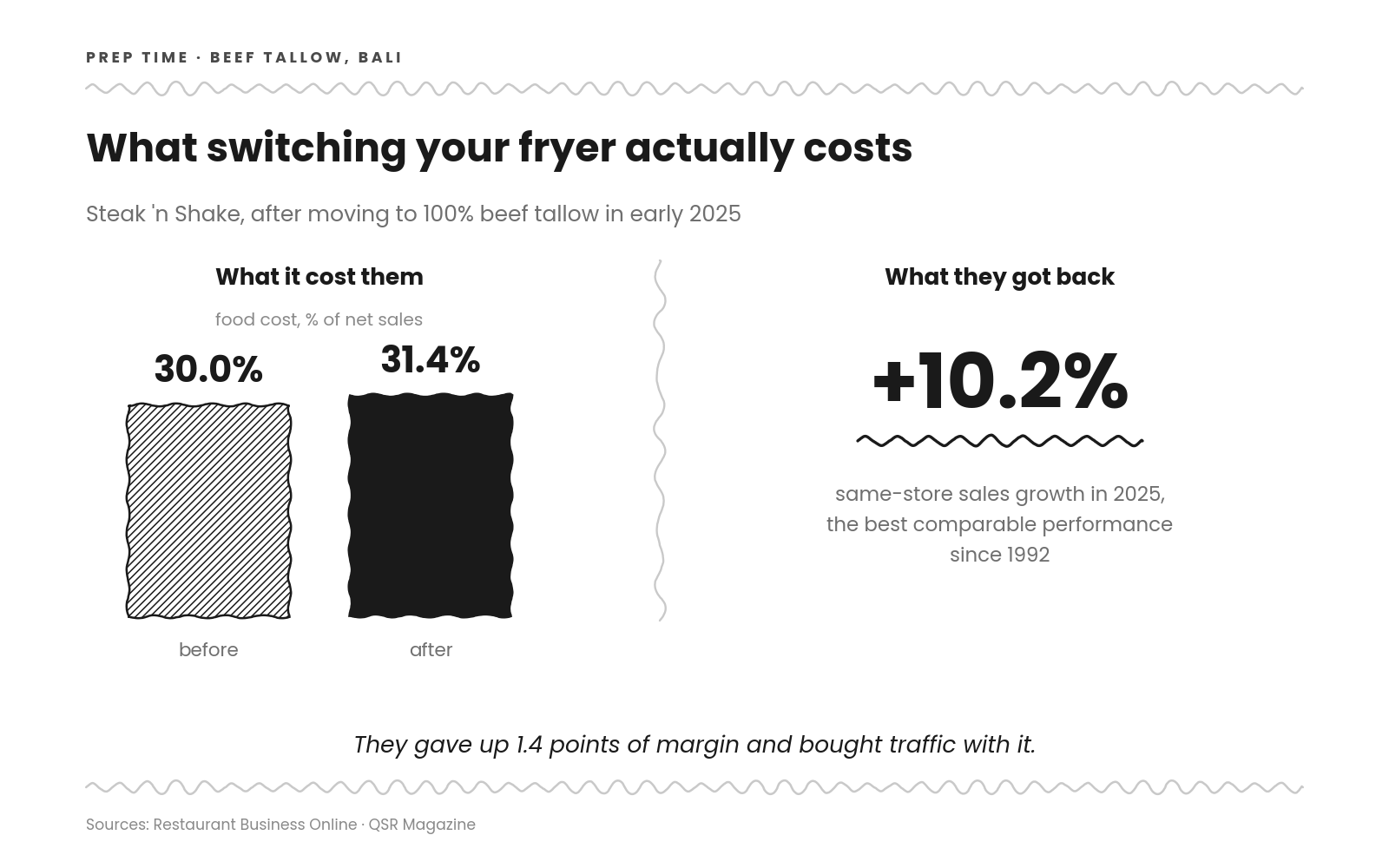
And now it’s swinging back. The 2026 US Dietary Guidelines promote cooking with butter, beef tallow and olive oil, and RFK Jr said he was “ending the war on saturated fats.” Steak ‘n Shake switched its fryers to 100 percent beef tallow in early 2025 and posted its best same store sales since 1992. SPINS data puts US retail sales of products containing beef tallow at around 1.1 billion dollars in the year to March 2026, up roughly 275 percent in three years. Conagra put it on the front of a bag of fries. Utz is frying chips in it.
Forty five years of policy, reversed, and the crew shirt in Pererenan is downstream of all of it.
Beef tallow vs seed oils: what the research actually says
Short answer, not really, and I want to be careful here because this is the part everyone gets loud about.
The strongest card the tallow side holds is a real one. Christopher Ramsden and colleagues recovered the lost data from the Minnesota Coronary Experiment and published it in the BMJ in 2016. It was a proper double blind trial, 9,423 people, 1968 to 1973, swapping saturated fat for linoleic acid. Cholesterol went down. Deaths did not. Ramsden’s argument is that trials like this got half published for decades, which made the swap look better than it was.
That’s a fair hit and it deserves to be taken seriously.
But then. A pooled analysis in Circulation looked at actual linoleic acid measured in people’s blood across 30 studies in 13 countries and found higher levels went with LOWER cardiovascular disease, stroke and cardiovascular death. Not higher. Lower.
And the American Heart Association’s line is blunt. Their 2024 piece is literally headlined “There’s no reason to avoid seed oils and plenty of reasons to eat them.” Stanford’s Christopher Gardner in that piece: “People are cooking with these oils, not drinking them.” His sharper point is that seed oils are getting blamed for the company they keep, because they live inside ultra processed food, and “it’s hard to cast the blame on the seed oils when these foods contain so many other things.”
Although, fairness, that same AHA article carries a correction from March 2025 because an earlier version got the inflammation mechanism wrong. Even the people telling you not to worry got a detail wrong once.
So the honest read is this. The scientific consensus has not flipped. What flipped is who’s holding the pen. And even the movement didn’t fully get its way, the 2026 guidelines promote tallow but never actually attack seed oils, which is a very quiet detail nobody posts about.
Oh and one more thing I enjoyed. Cate Shanahan, who’s called the mother of the seed oil movement, brands them the Hateful Eight. Two of the eight, corn and rice bran, are not seeds.
How palm oil replaced coconut oil in Indonesian kitchens
Here’s where it stopped being an American story for me.
We did this. Before we had a word for it.
Until the 1960s Indonesian households fried in coconut oil, pressed from kopra, the old dried coconut flesh. That was the fat. It was ours, it grew here, your grandmother used it.
Then the state chose differently. From the mid 1970s the government backed palm because it was faster and cheaper to produce, plantations went from 174,000 hectares in 1974 to around 200,000 by the early 1980s, and by 1984 palm was locked in as the flagship commodity while ordinary coconut got left behind. Coconut cooking oil faded out through the 90s.
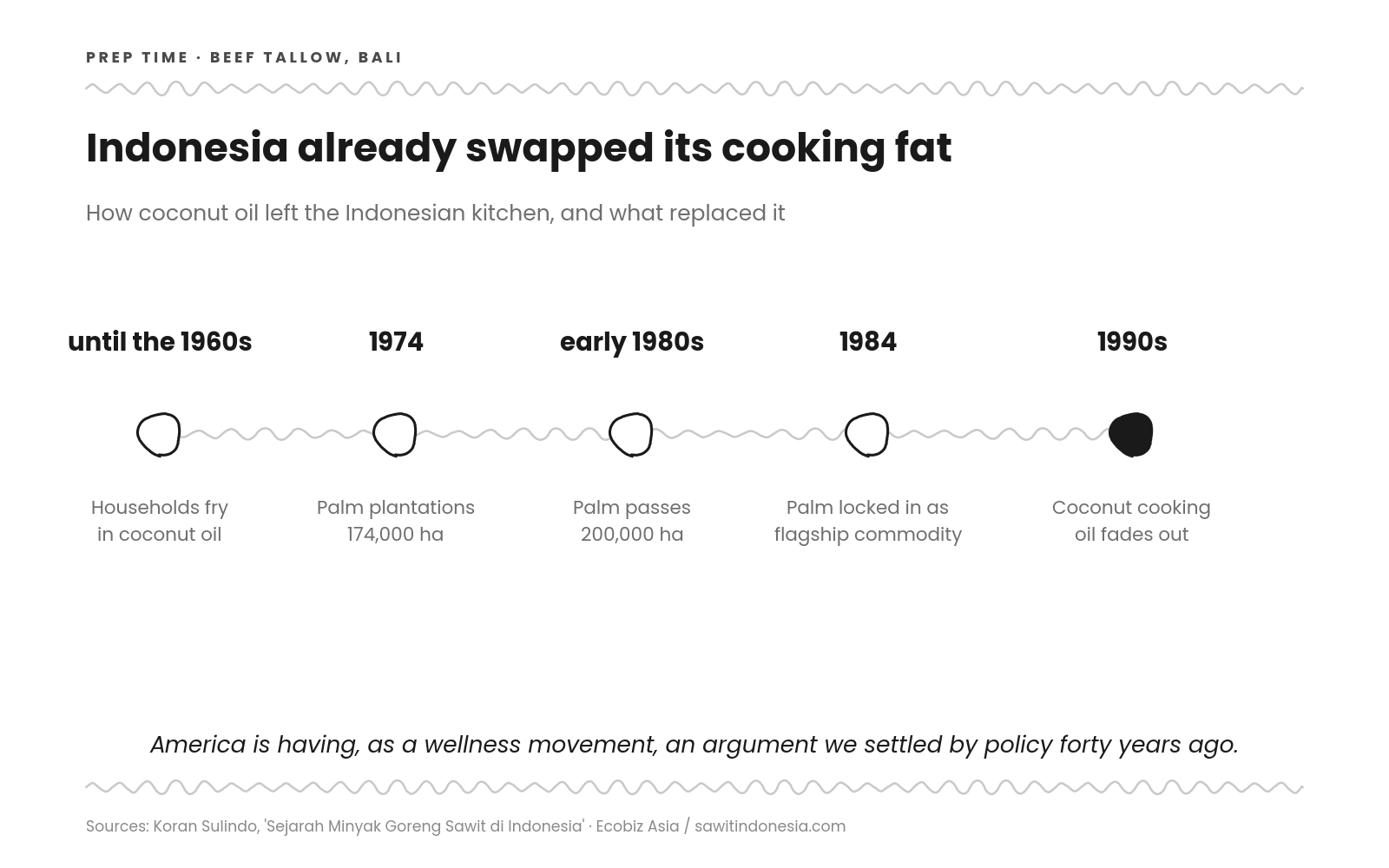
So while America is having a wellness movement about going back to the traditional fat, we already did the swap, forty years earlier, at national scale, by decree. And nobody here is nostalgic about it because nobody was asked.
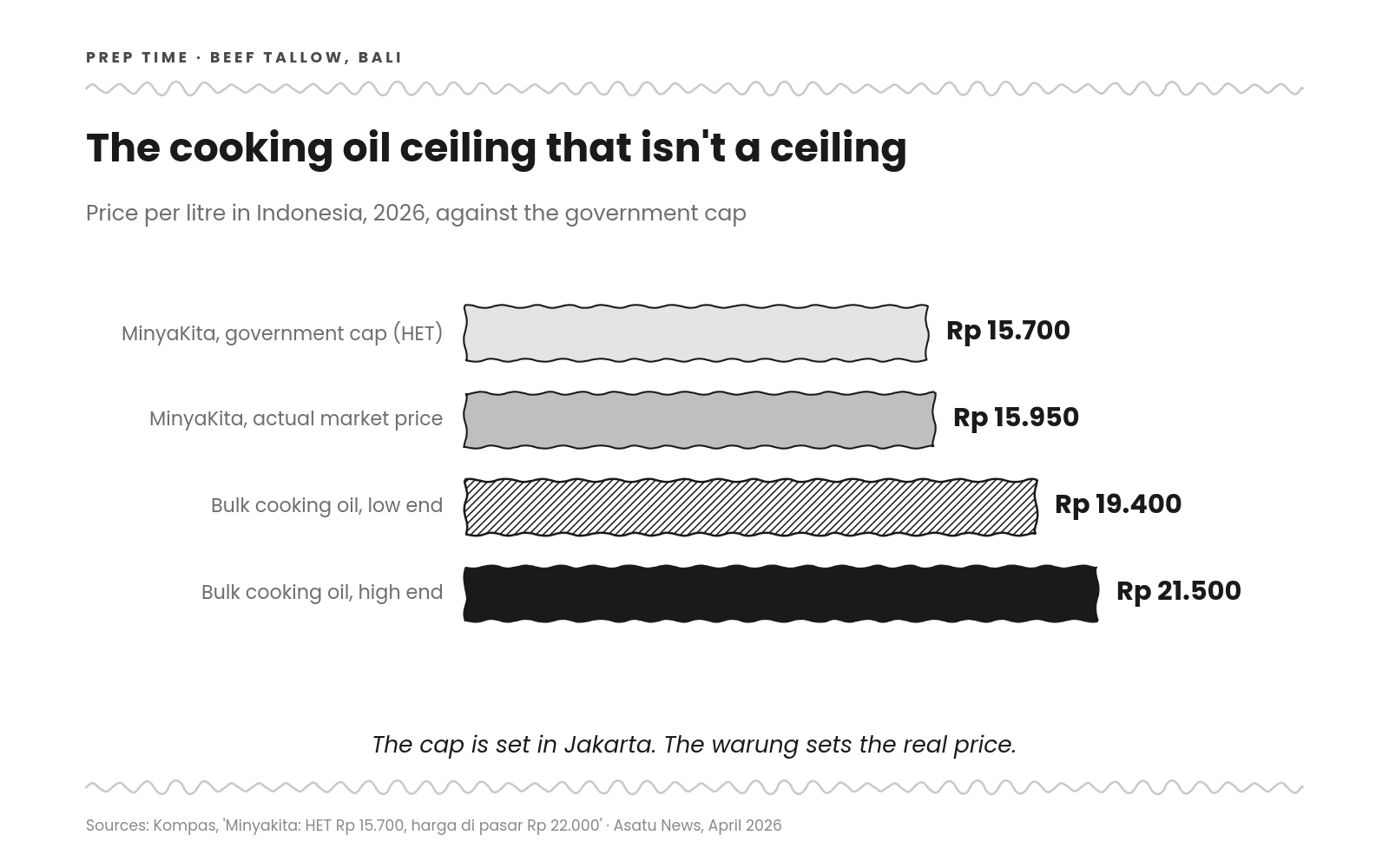
And cooking oil in Indonesia is not a lifestyle choice. It’s a political object. There’s a government price ceiling on it. MinyaKita’s HET sits at Rp 15,700 a litre, and it doesn’t hold, real prices run above it, and plain bulk cooking oil was going for Rp 19,400 to Rp 21,500 a litre in late April 2026.
The government is also now fighting for the leftovers. Permendag 2/2025, in force since January 2025, tightened exports of used cooking oil and palm residues specifically to keep raw material at home for cooking oil and to feed the B40 biodiesel mandate.
Read that again. Your jelantah is now strategic. The oil you already fried in is being fought over as fuel.
Where does beef tallow in Bali come from? Not from Bali cows
This is the bit that changed my mind about the whole business question.
I assumed, lazily, that a Bali tallow supply would come from Bali cows. It almost certainly doesn’t.
Bali has roughly 353,000 head of beef cattle. Sapi Bali is a small, lean tropical breed. A study of carcass composition at the slaughterhouse found separable fat making up only about 1.25 to 2.15 percent of the carcass, rising with slaughter weight, across animals slaughtered at 225 to 300 kilos. For comparison, that’s a fraction of what a grain finished Western animal carries.
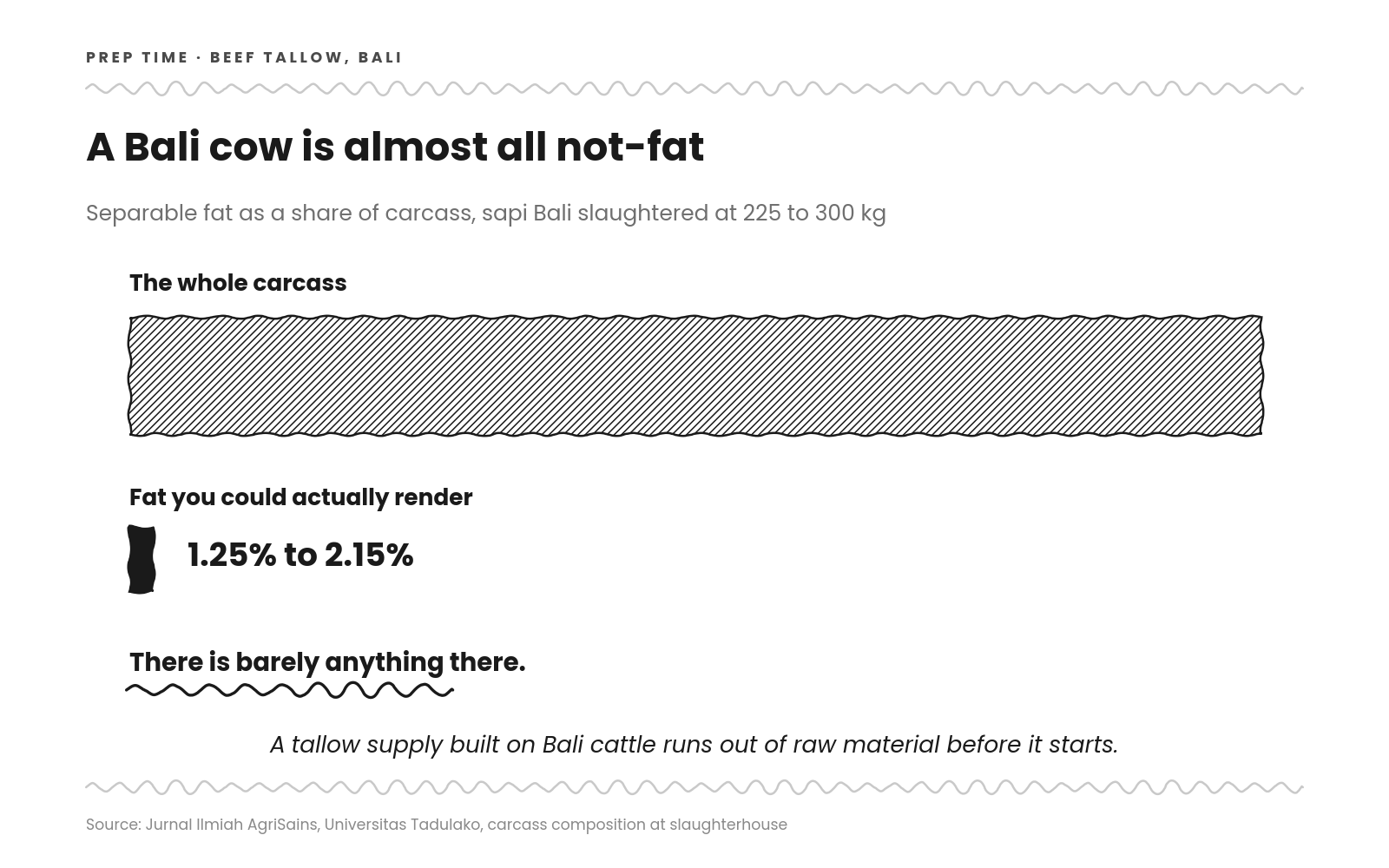
You cannot build a rendering business on that. There’s barely anything to render.
Then there’s who eats it. Cows are sacred in Balinese Hinduism and beef is rarely eaten, most strictly among Brahmin and Kshatriya families, less absolutely further down, and buffalo gets used ritually precisely because it’s exempt from the cow’s status. I don’t want to flatten this into “Balinese don’t eat beef,” because that’s too neat and it isn’t true across the board. But it does mean the demand for beef here leans heavily on Muslim Indonesians, Javanese workers and tourists, and the supply chain is built accordingly.
Nationally we don’t even have enough beef for ourselves. The Ministry of Agriculture estimated 2025 supply at about 491,700 tonnes against consumption of 724,200 tonnes, a deficit of 236,500 tonnes, covered by imported feeder cattle and frozen meat. The 2026 gap is projected to be bigger.
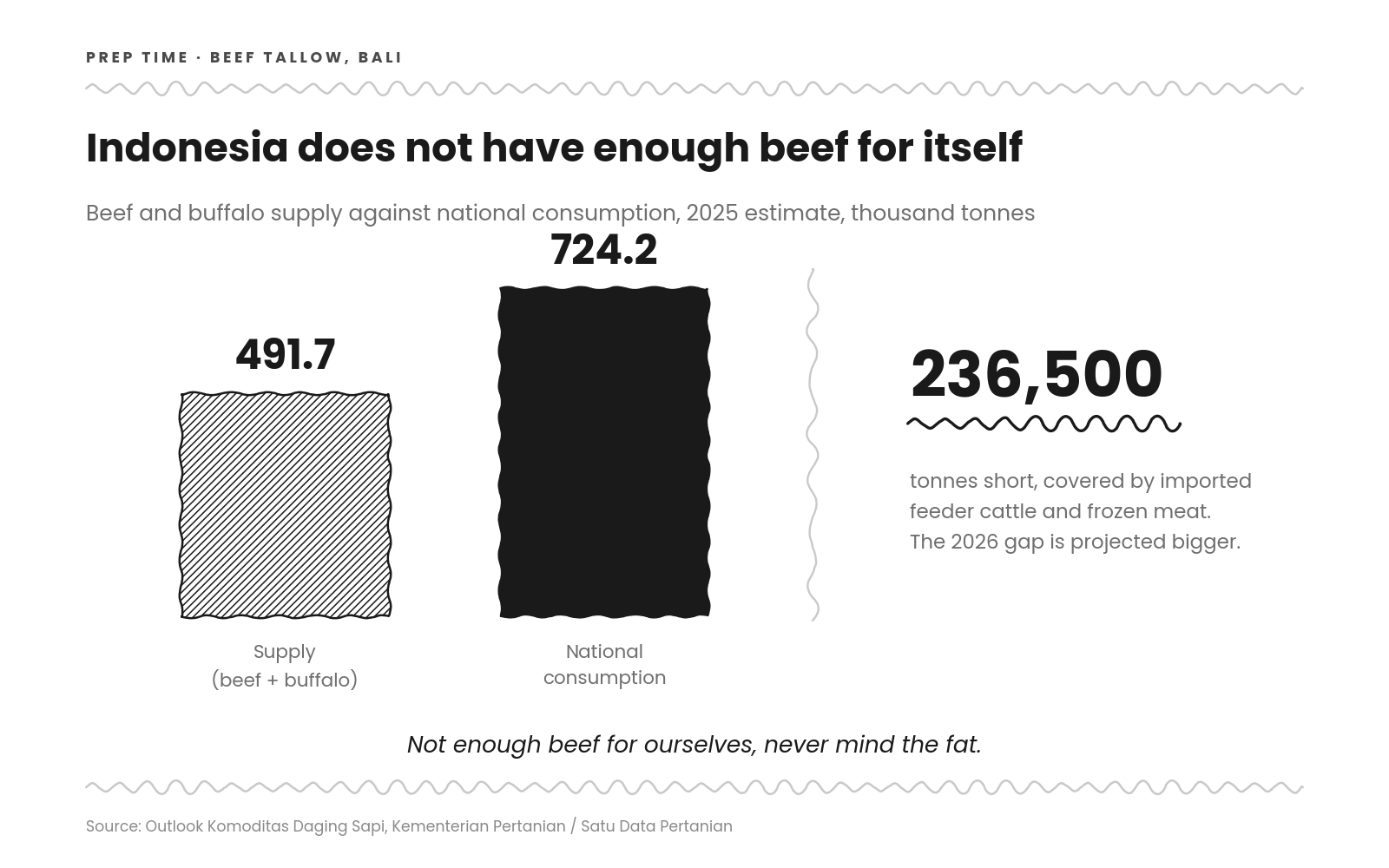
So the tallow in that fryer in Pererenan is, in all likelihood, imported. On an island whose used cooking oil is being held back for fuel. Marketed as the natural, ancestral, local choice.
That’s the twist and I don’t say it to be mean about anyone. It’s just what the numbers say.
Is beef tallow better for deep frying than palm oil? The stability data says no
I went in assuming tallow’s economic case was fry life. It’s low in polyunsaturates, so it should survive the fryer longer, and longer fry life offsets a higher purchase price. That’s the argument you hear.
I could not make it stand up.
Standard palm olein has a Rancimat oxidative induction period of about 27 hours at 100 degrees. That is a genuinely excellent frying fat. And a 2025 study in Food Chemistry comparing beef tallow’s frying performance against other fats found that despite tallow’s inherent stability suggesting it should hold up beautifully, most of the samples tested performed similarly to or worse than high oleic sunflower.
So the fat that Indonesia flooded its own kitchens with, for reasons that had nothing to do with health, happens to be one of the better things you can put in a deep fryer.
Which means if you switch to tallow, you’re not buying performance. You’re buying flavour, and you’re buying the story on the t-shirt. Those are legitimate things to buy. They’re just not the same thing as an efficiency.
The beef tallow business opportunity in Bali, in three layers
Three layers, and they point in slightly different directions.
Layer one, the demand is real and it is foreign. Bali took 6,948,754 direct foreign arrivals in 2025, up 9.72 percent, with Australians at 1.63 million the single biggest group. Australians, Americans, Brits. Exactly the populations where 28 percent now say they avoid seed oils. You are not selling to Bali. You are selling to people who flew here already believing this, and Butter Protein Club figured that out early.
Layer two, the supply gap is the whole opportunity, and it’s boring. Nobody in Bali is producing halal certified, food grade, consistent beef tallow at commercial volume. And the certification isn’t optional anymore. BPJPH’s mandatory halal regime explicitly lists edible beef fat, dripping and tallow as products requiring certification, and it applies to imports too. That’s a barrier, which is exactly why it’s a moat for whoever does it properly. The catch is the raw material. Local sapi Bali won’t feed it, so a serious operation is buying trim from Java or importing, and at that point you are a processor and a distributor, not a farm to fryer story.
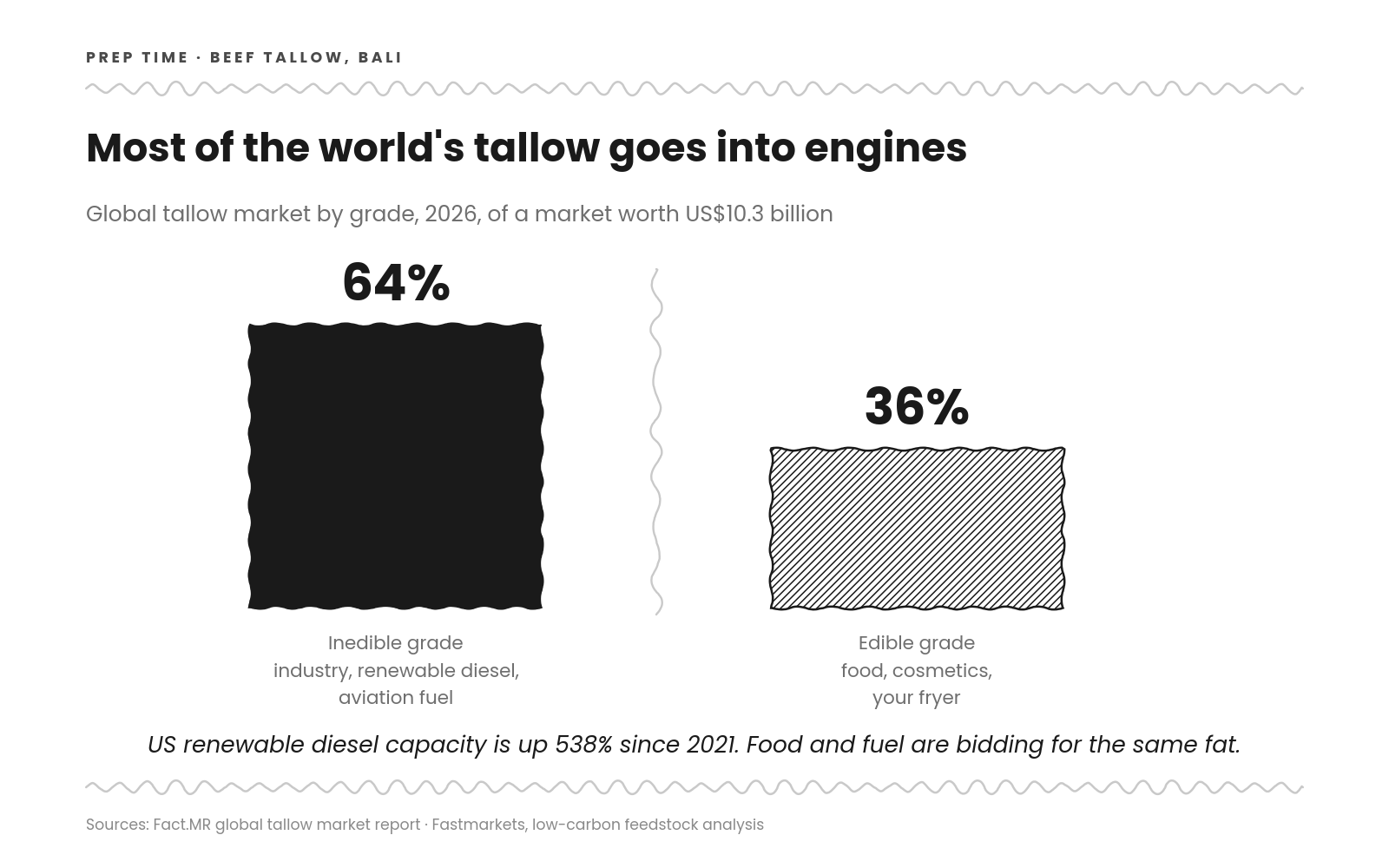
Layer three, and this is the one that worries me, everyone wants this fat for fuel. The global tallow market is put at 10.3 billion dollars in 2026, forecast to more than double by 2036, but around 64 percent of that is INEDIBLE grade going into industry and energy. US renewable diesel capacity is up 538 percent since January 2021 and tallow, used cooking oil and animal fats have become structurally constrained commodities. Indonesia is doing its own version with B40. So the food business and the fuel business are bidding for the same barrel, and the fuel business is much bigger than you.
And for anyone running a kitchen here rather than building a supplier, the operator maths is less scary than it sounds. When Steak ‘n Shake switched, food cost went from 30 to 31.4 percent of net sales. A 1.4 point gross margin hit. They absorbed it because traffic went up. That’s the whole trade in one number. It costs more, and it only works if it brings people in the door.
Utz’s chief executive Howard Friedman has said the quiet part about all of this, that consumer interest could fade as fast as it arrived and flexibility matters more than committing your whole portfolio. He’s right. This entire category is currently attached to one administration’s dietary guidance in a country most of these customers are only visiting.
So should a Bali kitchen fry in beef tallow, or in coconut oil?
The thing I can’t shake is the coconut.
If what people actually want is a traditional, local, minimally processed cooking fat with a real story attached, Bali is sitting on it. It grows here. It was the default until the state decided otherwise. It’s already what Butter Protein Club uses for its vegan dishes. And Indonesia’s coconut oil industry is right there, underbuilt, waiting.
Beef tallow in Bali is an imported answer to an imported question. Which doesn’t make it a bad business. Imported answers to imported questions is arguably the entire Canggu economy and I say that with love and as a participant.
But if I were putting money in, I’d be much more interested in the boring middle. Certified, consistent, food grade rendering that supplies twenty kitchens instead of one. The Paotere lesson again, honestly. The money isn’t in the fish. It’s in everything that happens between the boat and the plate.
So, my question for you, and I actually want to hear it. If you were opening a kitchen in Bali tomorrow, would you fry in beef tallow you have to import, or in coconut oil that grows down the road and has a better story than either of us has been telling?
And if you work in a Bali kitchen already, tell me what you actually fry in and what it costs you. That’s the number nobody publishes and I’d love to know.
Thanks for reading Prep Time. If your kitchen changed its oil in the last two years, for any reason, I want to hear why.