

Someone at our hotel told us there was a funeral happening in a village nearby and that we should just come. We went, felt awful about it the entire drive, and then a woman I’d never met put rice in front of me and force me to eat.
It’s been a few days and I keep going back to the moment in the parking lot where we almost turned around. So. Toraja..
Can tourists attend a Rambu Solo’ funeral in Toraja?
We were at our hotel and someone mentioned, casually, that there was a Rambu Solo’ happening in a village not far from us. A funeral. Come if you want, they said.
And I want to be honest about the next ten minutes of my life, because I think this is the part people don’t talk about. I felt weird about it. Somebody’s mother or father or grandfather had died, their family was burying them, and I was going to turn up as a stranger that got invited by a fellow invitee. Nobody in that family had asked for me.
Then the road made it worse.
It was maybe ten minutes of what was essentially off-roading. Not a road with potholes. The potholes had a road situation. We’re getting thrown around inside the car.
We got there and there were cars everywhere. Proper parking chaos. And we sat in it, not getting out, having the same conversation on loop. Do we go in? Should we not? Is this okay?
The guy directing cars looked at us, read the whole thing off our faces in about a second, and as we ask is it actually okay if we get inside, he said of course, just go in, there are a lot of foreigners there.
What a Rambu Solo’ funeral actually looks like: the rante, the lantang and a church PA
You walk in and it does not feel like a funeral. Not in the way my body understood funerals.
It felt like a village get-together. Thousands of people. And the shape of it is an arena, an open field with structures built up around the edges, maybe ten different sections all facing in.
Those sections have a name, I looked it up after. They’re called lantang, temporary pavilions built out of bamboo and wood specifically for the ceremony, where guests sit and where families who’ve travelled in actually sleep for the duration. The field itself is the rante, the ceremonial ground. Somebody built all of that. Somebody will take it all down. Hold that thought, we’re coming back to it.
We arrived in the middle of a church service and just stood there, in the open, not knowing where to put ourselves.
As we walk inside, people started moving us with their faces. Eyes, eyebrows, a tilt of the head, mouthing go there, go there, that section, all of it silent because there was a priest preaching going on. A whole crowd quietly running air traffic control for two strangers who clearly had no idea what they were doing.
We sat down. The prayers kept going. And it was a full church setup, the pastor, the whole church crew, singing, on microphones, through big speakers. Which surprised me and shouldn’t have. Most Toraja are Protestant, and the funeral you’re watching is a genuine negotiation between the church and aluk to dolo, the ancestral way, which is the older system all of this comes from. There’s an entire body of research on how those two things share a field. Then the prayer finished and the family came out.
They’re the ones in all white. That’s how you find them. And they came around and greeted people, greeted us, held our hands, smiling, telling us to eat after this.
I don’t want to over-read a stranger’s face at their own family’s funeral. But I’ll say what it looked like to me, which is that they seemed genuinely glad the room was full. As the family members greet and host the guests they met and talked to along the way.
What they feed you at a Toraja funeral, and why they will not let you say no
Twenty, thirty people carrying rice and dishes out from the kitchen in a steady line, and I felt awful all over again, because I hadn’t been invited, I’d come unannounced, and now I was going to eat their food.
I’d made peace with it. If we don’t get fed, fine, completely fair, we shouldn’t be fed.
And then a Torajan auntie looked at me and said “sudah makan belum?” Have you eaten yet.
“Not yet,” I said.
“Sit down, sit down, I’ll bring you rice.”
And then it was everyone. Food appearing in front of us, people telling us to eat, eat, eat, that specific Indonesian insistence where declining is not really an available option. Fish. Eggs. A vegetable dish. Rice. Buffalo. Pork.
And ballo. Which is Torajan palm wine, tapped from the sugar palm they call inru, fermented with tree bark until the sweetness turns, sitting somewhere around 4 to 5 percent alcohol, so about a beer. Cold, sour, weirdly refreshing. They’d brought it in jerrycans. Litres and litres of it.
I sat there with a plate I hadn’t earned, drinking palm wine at a stranger’s funeral, being told off gently for not refilling my plate fast enough.
Here’s the thing I only understood later.
Indan: why the meat at a Toraja funeral gets written down as a debt
The meat handed out at a Rambu Solo’ is not catering. It’s accounting.
Buffalo and pigs arrive at these ceremonies as contributions from guests, from extended family, from neighbours. And every single one of those contributions gets written down by adat officials, because it’s a debt. There’s a word for it. Indan.And there’s a word for settling it, umbaya’ indan, which happens years later when the person who gave you a buffalo has their own death in the family and you send one back.
The debt cannot be called in. Nobody chases you. And it gets repaid anyway, basically always, on trust.
The distribution itself happens in public and on purpose. There’s a structure built for it called a bala’kayan, a raised platform near the tower where the coffin sits, and the meat is divided up there in full view of everyone, deliberately, so that the whole village can watch who gets what. Transparency as architecture.
Then it goes out through the saroan, which is the village grouping, roughly the scale of an RT or RW, each one with a coordinator. Names get called out one by one. Half a kilo to a kilo per household.
Overseeing all of it is the tominaa, the ritual specialist, who recites the family genealogy, decides when each stage of the ceremony happens, and leads the division of the meat. He is, functionally, the auditor.
And it matters that much. In one case in Toraja, a disagreement over meat division ended with a man stabbing his neighbour. People do not get stabbed over catering. They get stabbed over ledgers.
So the room I walked into, thinking it was a party, was a settlement day. Hundreds of accounts opened, closed, rolled forward, in meat, out loud, in front of everyone.
How much does a Rambu Solo’ cost? The tiers, from dasilli’ to rapasan
Rambu Solo’ comes in levels. Dasilli’ is the smallest. Dipasangbongi runs a single night and is the ceremony for commoners, historically the tana’ karurung. Then it climbs, more nights, more animals, up to rapasan, which is for high nobility and is not funded by one household at all, it’s funded by an extended family network. That stratification is old and it’s still legible in how many nights you get and how many buffalo die.
Numbers you’ll see quoted: eight to ten buffalo plus a large number of pigs for a middle-class family, and anywhere from 24 to well over 100 for the top tier.
The ceremony also has a rhythm with names for each part. Ma’badong, where men form a circle and chant for the dead with no instruments at all, just voices. Ma’pasonglo’, the procession that carries the deceased to the lakkian, the tower on the ceremonial ground. Ma’tinggoro tedong, the buffalo slaughter, done in a single stroke, which is a specific and prized skill.
Pasar Bolu buffalo market prices: what a tedong saleko actually costs
Also, Toraja has the largest livestock market in Indonesia, Pasar Bolu in Rantepao. It runs on a six day cycle. Roughly 90% of the buffalo traded there are bought to be killed at ceremonies, not for farming and not for meat.
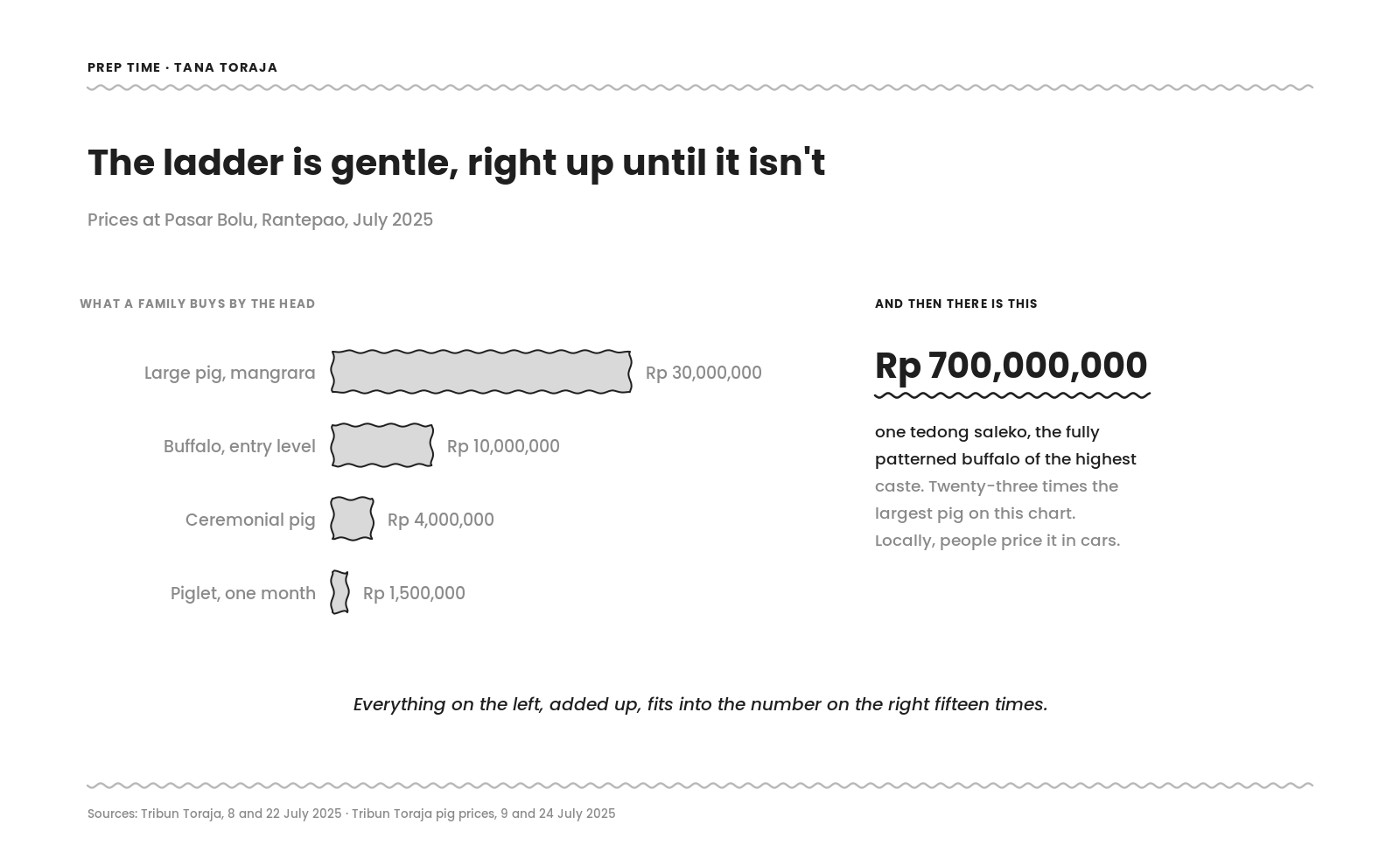
Prices, as reported by Tribun Toraja in July 2025, start around 10 million rupiah and run to a billion. At the top sits tedong saleko, the fully patterned buffalo, going for IDR 500 to 700 million that month, with historical spikes past a billion.
I love that the Indonesian coverage doesn’t bother converting that to dollars. It just says: a Pajero Sport. That’s the unit. A car with a spotted hide, walked into a field, killed in one stroke.
Pigs run 1.2 to 1.5 million for a piglet, from 4 million for a full-grown ceremonial pig, and 10 to 30 million for the big ones.
Bolu turns over somewhere between 600 and 800 million rupiah a day, more in ceremony season.
And my favourite number in this entire piece, because it’s the only one that shows you an actual person’s ledger: a study of pig traders at Bolu out of Universitas Bosowa found an average monthly cost of Rp161,792,918 and an average monthly profit of Rp28,046,476. About seventeen percent. Somebody is running a real business in the middle of all that grief, and running it thin.
Where Toraja’s buffalo actually come from, and it isn’t Toraja
This is the fact that reframed the whole trip for me.
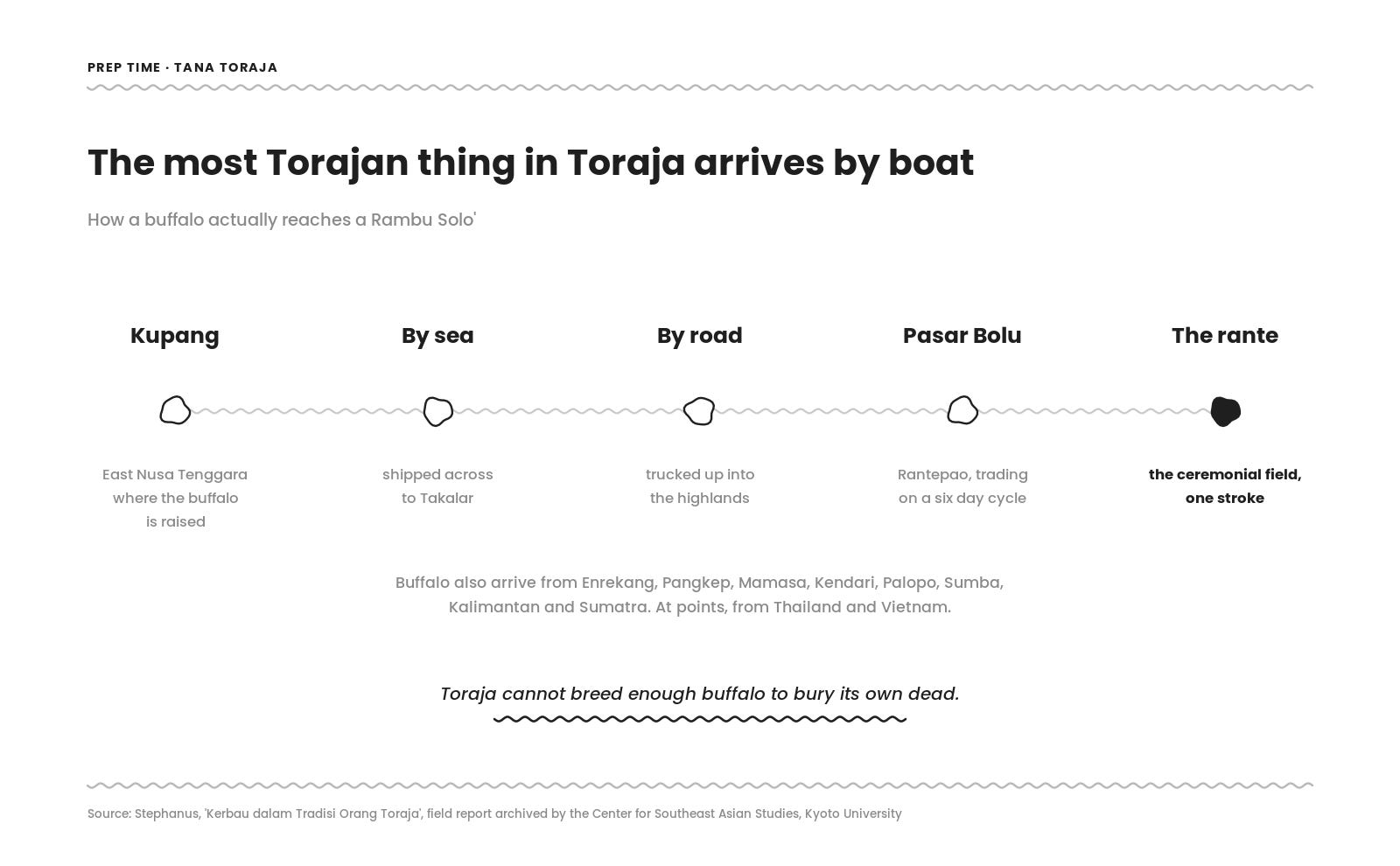
Toraja cannot breed enough buffalo to bury its own dead.
According to field research archived at Kyoto University’s Center for Southeast Asian Studies, the animals come in from Enrekang, Pangkep, Makassar, Mamasa, Kendari, Palopo, and above all from Kupang in East Nusa Tenggara. Kupang is the big one. They go by sea to Takalar and then get trucked up into the highlands. More arrive from Sumba, Kalimantan, Sumatra. At points, from Thailand and Vietnam.
So the most rooted ritual I have ever personally stood inside, a ceremony that is entirely about belonging to one specific piece of mountain, is fed by boats.
The money doesn’t stay either. It leaves for Kupang.
Layer one: Toraja’s slaughter fee, and the buffalo nobody counts
Both regencies charge a slaughter fee at these ceremonies, a retribusi pemotongan hewan. Rates run roughly 100,000 to 1 million rupiah per animal depending on the animal.
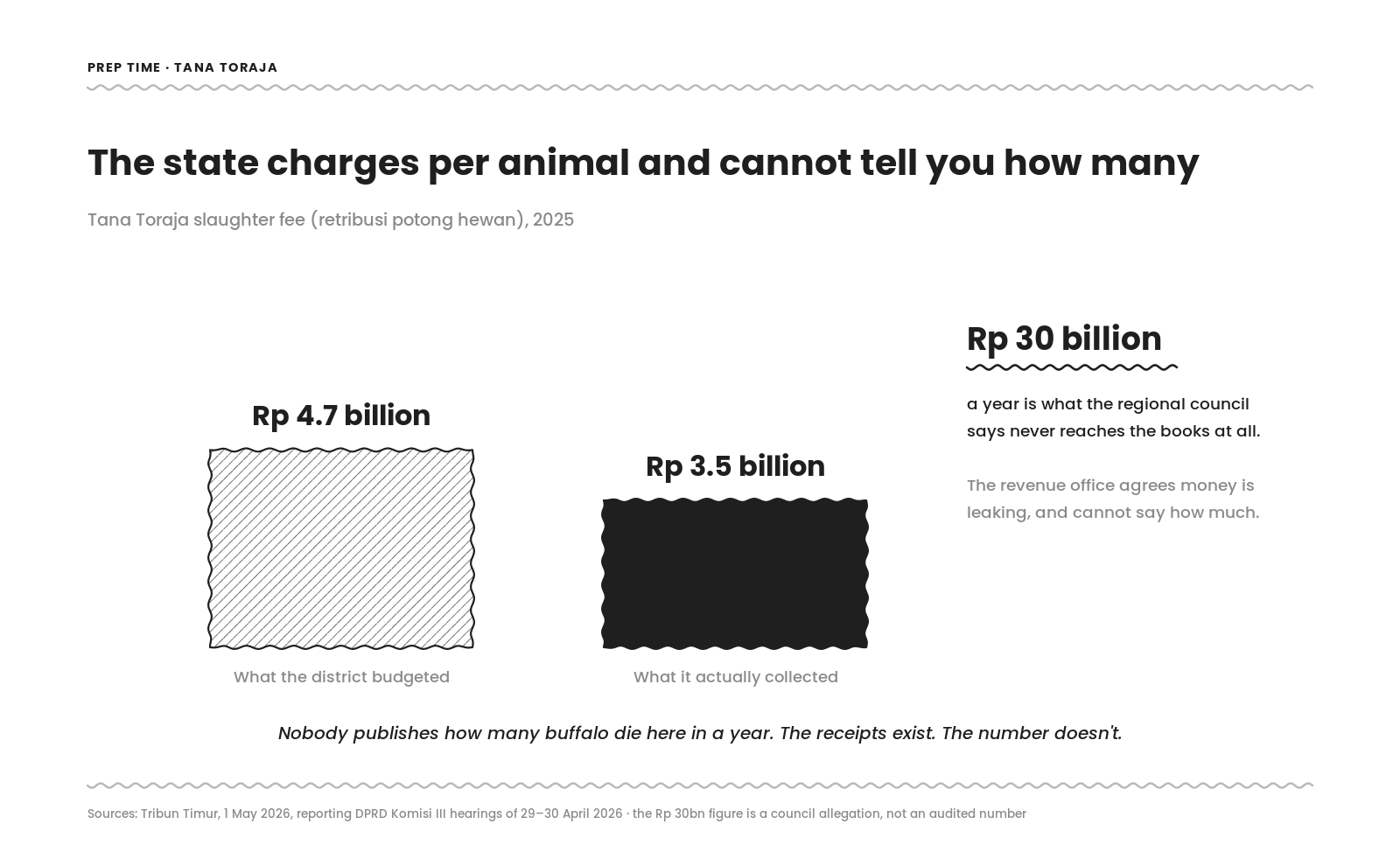
In 2025 Tana Toraja collected about 3.5 billion rupiah against a target of 4.7.
Then in hearings on 29 and 30 April 2026, the regional council went at the revenue office about it. The head of the revenue division, Aritini, admitted on the record that money is leaking and said she could not tell them how much. She blamed weak supervision at village level, where collectors work directly at ceremony sites. The council rejected that and said the collectors and the supervisors are working together. The figure attached to the story in the headline is 30 billion rupiah a year.
I want to be careful here because that 30 billion is a council allegation, not an audited number, and I’d be a hypocrite to repeat it as fact.
But here’s what gets me, and it’s the same feeling I had standing in Paotere doing bad maths about tonnage. Nobody knows how many buffalo die in Toraja in a year. I looked. It isn’t published. Not by the statistics agency, not by the regencies, not in any of the academic literature I could find.
And yet the state charges a fee per animal. Which means somewhere, in a drawer, in a village office, there are receipts. There is a number. It’s just not a number anyone has assembled or wants to.
Every “the Toraja funeral economy is worth X” claim you’ll find online, and there are many, and some of them are in US dollars with confident-looking ranges, traces back to nothing. I chased them. There’s no survey underneath. There’s no source. People made them up.
Layer two: why Toraja’s buffalo are stuck at the port in 2026
On 3 August 2026, Frederik Kalalembang, a member of the national parliament, publicly asked the South Sulawesi provincial government to review a governor’s circular restricting livestock movement, brought in over foot and mouth disease.
His complaint was specific. Buffalo have arrived at port and are being sent back to where they came from, because the circular is still being applied.
And his argument was purely economic. More supply means lower prices for families who have a body waiting at home. He also made the tourism argument outright: people come here to see this, and the buffalo are part of what they come to see.
Sit with the shape of that for a second. A ritual that exists to settle debts between families, dependent on a supply chain from another island, now gated by a provincial disease circular. Three completely different systems, and the one that gives way is the family with a coffin in the living room.
Layer three: how a Japanese company trademarked the word Toraja in 1974
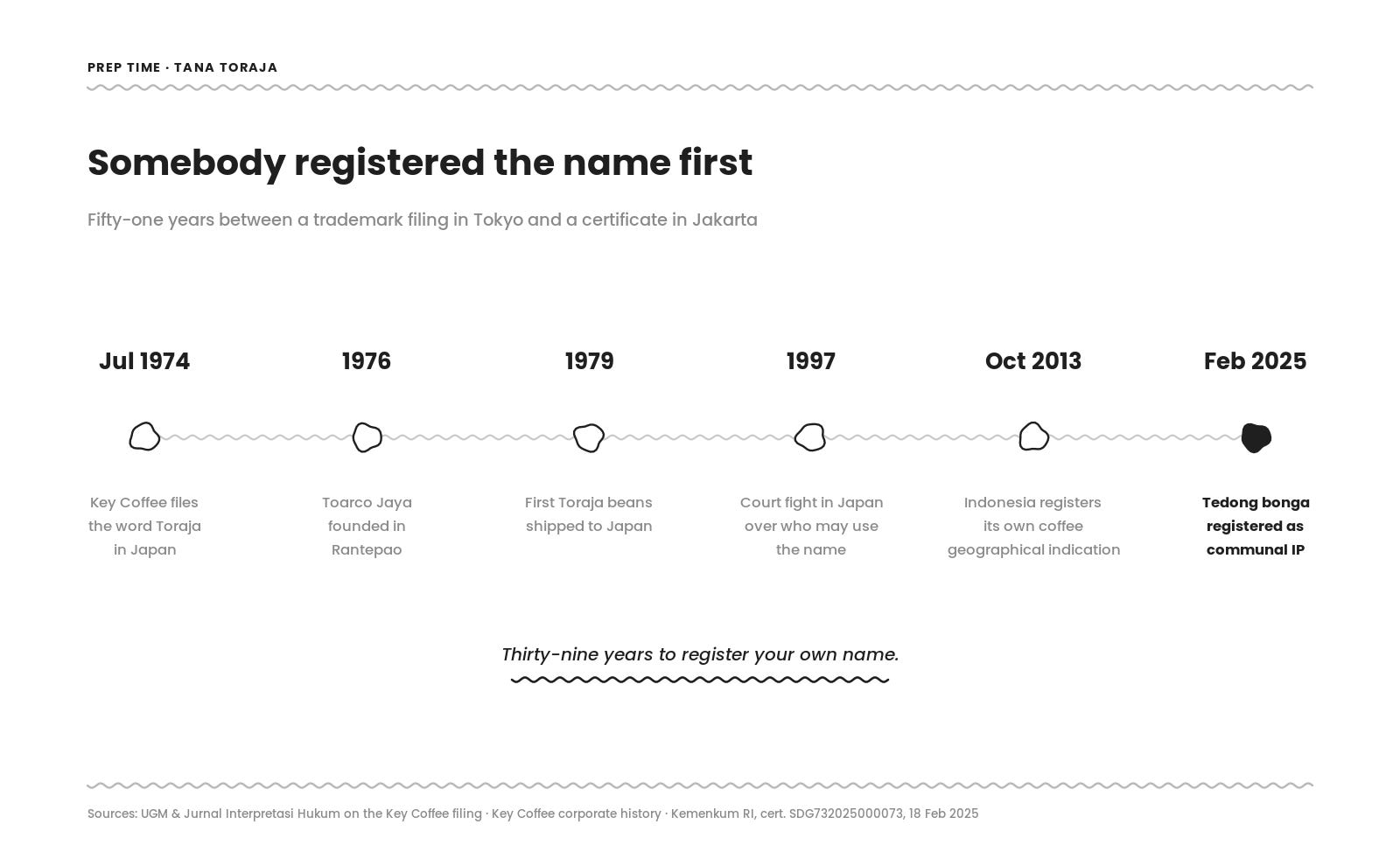
On 18 February 2025, Indonesia’s Ministry of Law issued a certificate registering tedong bonga, the piebald buffalo, as Communal Intellectual Property under the genetic resources category. Number SDG732025000073. Filed by the agriculture departments of both Toraja regencies.
The head of the regional law office, Andi Basmal, framed it plainly: protect the culture, raise the economic value of these two districts, support tourism.
Good. Genuinely good. A community registering its own distinctiveness as an asset.
Now hold that next to this.
Toraja coffee is one of the great coffees on earth. In April 1973, a Japanese company sent an executive to Sulawesi to find out what had happened to it, because it had been prized before the war and then vanished off the world market. By 1976 there was a joint venture, PT Toarco Jaya, between Key Coffee and Toshoku. First beans shipped to Japan in 1979. They built roads and schools and processing stations. That part is real and it matters.
But on 22 July 1974, before any of that, Key Coffee filed to trademark the word Toraja with the Japanese patent authority. “Toarco Toraja” was registered there in 1977. In 1997 there was litigation in a Japanese court over who got to use the Toraja name, after another company registered its own Toraja mark in 1992.
Indonesia did not register Kopi Arabika Toraja as a domestic geographical indication until 9 October 2013.
Thirty-nine years.
Indonesian legal scholars have written about this repeatedly, including theses out of UGM and work in the Jurnal Interpretasi Hukum, and they’re blunt about it: the country ended up at a legal and commercial disadvantage using its own place name.
So read the two dates together.
1974: someone else registers the name of your mountains. 2025: you register the hide of your own cow.
That’s the same lesson, fifty-one years apart, learned the second time considerably faster. And I don’t think it’s a coincidence that the second one happened in a district that has watched the first one play out in its own coffee for half a century.
The real business opportunity in Toraja isn’t more tourists
Not more tourists. I want to be really clear about that, because it’s the lazy answer and the numbers don’t support it.
Foreign visitor arrivals to North Toraja were reportedly around 32,272 before the pandemic, then 730 in 2020, then 179 in 2021.
One hundred and seventy-nine people. And the funerals kept happening. The buffalo kept arriving from Kupang. The meat kept getting recorded.
That tells you which economy is load-bearing, and it isn’t mine.
The opportunity is in the gap, same as it was at the fish market. It’s the boring stuff. It’s counting the animals so a district can actually budget. It’s breeding programmes so the buffalo don’t all have to come by boat from another island. It’s the lantang crews and the caterers and the woman who cooked rice for a thousand people that afternoon, none of whom appear in a single document I could find. It’s a shelf of Toraja products that carry the Toraja name on paper Indonesia owns.
And underneath all of it, a system for pooling money across hundreds of households, over decades, on nothing but trust and a written record, that has been running longer than any bank in the province and that no economist has properly measured.
They call it indan. Debt.
So here’s my question, and I actually want to hear it.
If you were building something here, would you try to formalise a system like indan, put it on paper, make it legible, make it fundable? Or is the fact that nobody can measure it exactly the thing that makes it work?
Thanks for reading Prep Time. If you’re Torajan and I got something wrong in here, please tell me. And if you know a place that runs on a ledger nobody has ever added up, I want to hear about that too.