

I went to Paotere fish market at 7 in the morning expecting it to reek, and it didn’t, and that turned out to be the least surprising thing about the place. I found out the fish I was looking at had been caught before midnight and that a barracuda as long as my height costs less than brunch.
It’s been a few days and my sandals still smell faintly of the ocean and of something that used to live in it. I’m not throwing them out tho, it’s worth it.
We left the hotel at 6:30 in the morning, and got there just before 7. We’d been asking around beforehand, “Which fish market to go? Rajawali or Paotere?” and every person answered the same way and answered it fast. If you want THE fish market. Paotere. Nobody said well it depends what you’re after. Just Paotere, like there was only one correct answer and I’d been a bit silly for asking.
What Paotere fish market actually looks like at 7am
The Grab drops you at the entrance and drives off, and the first thing that happens is that you don’t see the fish market immediately.
You’re in a long alleyway of kiosks. They’re selling food, bags, the ordinary stuff any traditional market anywhere sells. It could be any pasar in the country. There’s no gate, no sign going FISH THIS WAY.
What tells you is the people coming the other direction. The entire time you’re walking in, there’s a steady counter-current walking out, and every single one of them is carrying fish. Heavy plastic bags of it, held out away from the body.
It’s 7am, they’re finished with their morning, when mine hasn’t started yet. That was the first moment it properly landed that I was arriving late to something.
I had also braced for the smell, and I was expecting that thick funk you get from walking past a supermarket seafood counter near closing. I had decided in advance that I was going to be very mature about it.
But not at the entrance, not further in, not at the boats. It never came. I didn’t understand that at the time. I understood it completely a few hours later, but let me not skip ahead.
Inside Paotere: wet floors, motorbikes and everyone shouting
You don’t arrive at Paotere. It starts happening around you before you get there.
Still outside the main-roofed-market part, still technically in the walkway, and there’s already shrimp on the ground in front of you. Squid. Fish laid out on sheets of plastic at your feet, so you’re immediately doing that careful “walking on eggshells” where you’re looking for parts of the road where it’s less watery. Then you’re under the roof and the volume goes up. People calling you out, working for your attention, because in a room where everyone is selling more or less the same thing, attention is the only lever anybody has.
Walk farther down, you start seeing motorbikes come through. Actually through, not around, styrofoam boxes strapped to the back, and everyone steps aside without looking up.
And the water. The floor is not damp, it is WET, in every direction, seawater and melted ice and whatever else, and it is going on your feet whether you like it or not. Wear sandals you have already emotionally let go of. That is my one practical piece of advice in this entire article.
The boats, the barracuda, and Makassar fish prices that stopped me
Then you keep walking and the market opens up and there are boats.
Not two or three picturesque ones. A wall of them, hull against hull, loading and unloading, and behind those, more. The impression is that it doesn’t end. Men moving crates, ice going one way, fish coming the other. This is the part where I stopped trying hard to analyze and just stood there for a while.
And the fish coming off them.. A barracuda, easily a metre and a half, laid out on the wet concrete like a piece of furniture. Swordfish. A shark, a small one, maybe 50 centimetres, which I did not expect and had to double check with the person I was with because I thought I wasn’t looking correctly. Crabs. Clams. Tuna in sizes I didn’t know tuna came in. Mackerel everywhere.
Then I started looking at prices.
The barracuda was Rp200.000. The whole barracuda. Longer than my torso. Whole beautiful fish going for Rp25.000, for Rp50.000. I did some bad calculation in my head, then did it again. Did I heard wrong?
How fish gets to Paotere: the 11pm to 5am night shift
I talked to a man named Samsul, who catches and sells his own fish, and I asked him the dumbest, most useful question I could think of, which was basically: can you walk me through your day.
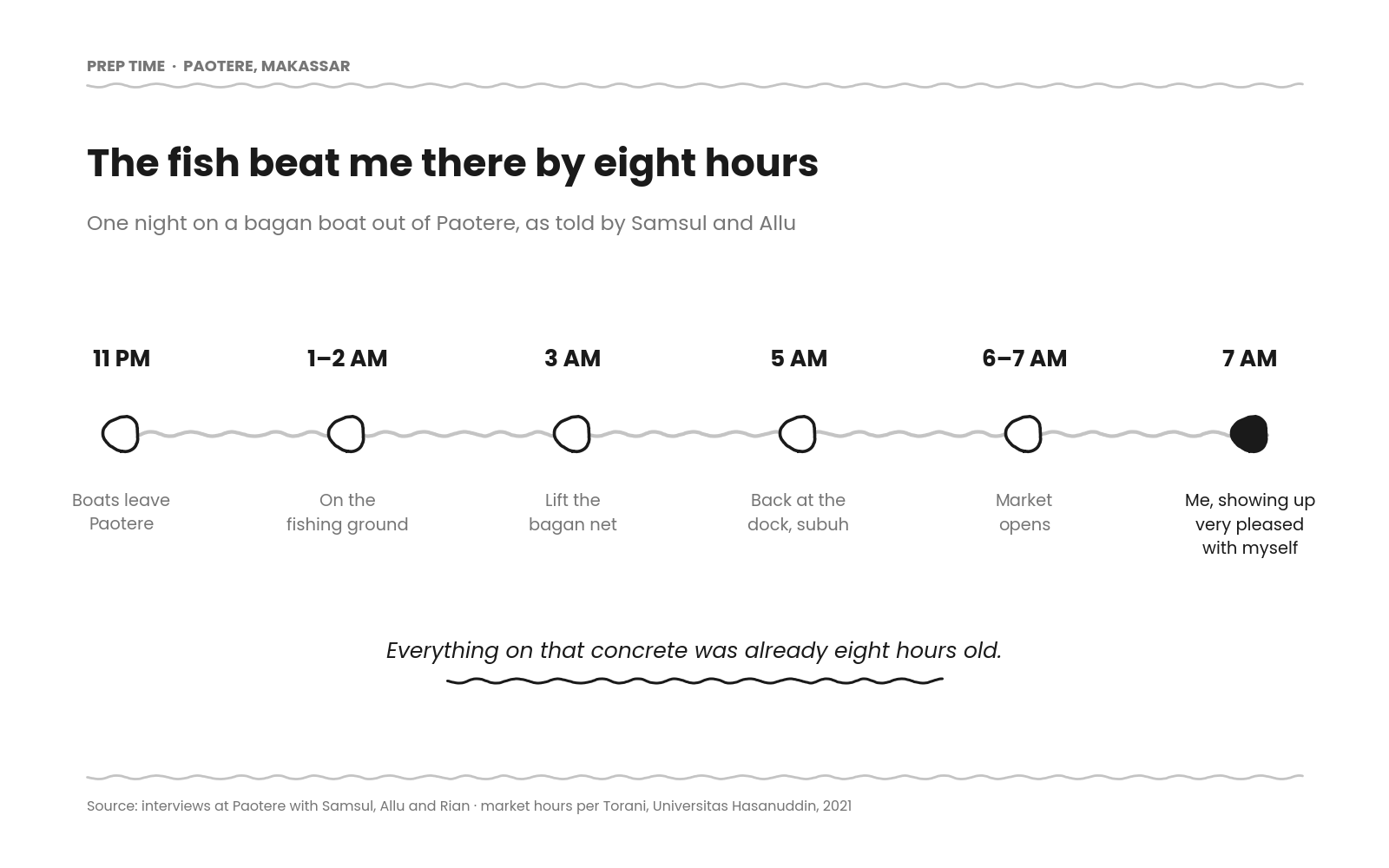
His day starts at 11pm. He leaves then, reaches the fishing ground around 1 or 2 in the morning, and works with a bagan, which is a lift net platform, the kind with lights that pull the fish up toward the surface in the dark. He hauls the net at 3am. He’s back at Paotere by 5am.
Allu, who sells squid, told me almost exactly the same numbers. Out around 11 at night, back at subuh, first light. He closes at 3 in the afternoon. Rian, another seller, goes out right after Maghrib prayer and gets in around 1 or 2 in the morning.
So by the time I rolled up at 7am, freshly showered, feeling quite proud of myself for being awake, every single thing I was looking at was already eight hours old and had been hauled out of the Makassar Strait in the dark by someone who had not slept.
The market’s official rhythm matches this exactly. Researchers from Universitas Hasanuddin who studied Paotere’s operations found marketing runs in two shifts, roughly 5am to 10am and then 1pm to 5pm. Samsul put it more bluntly. The fastest it sells out is 9am. If there’s stock left it drags to noon, and then he comes back for the afternoon round, 2 till 5. Rian said the same, morning from 6, second wave at noon.
The same study counted about 5,000 people moving through that port on a normal day. Fishermen, pond farmers, port staff, collectors, and people like me and you just buying dinner.
Who actually sets fish prices in Makassar (it isn’t the auction)
Here’s where it got interesting for me.
The place is officially called a Tempat Pelelangan Ikan. A fish AUCTION place. Allu, when I asked where we were, said “lelong Paotere,” the auction. The name is right there. The city has been trying to police that auction since the 1950s, and Makassar’s municipal archives show officials writing to the police in 1954 asking them to supervise it because of recurring chaos, which is a very funny detail to find in a government file.
And yet almost nothing I read about how prices actually get set in this part of Indonesia describes anything like an auction.
What it describes is a system called punggawa-sawi. A punggawa is a patron, usually a boat owner or a financier. A sawi is his crew, his client, the person who owes him. Anthropologist Andrew McWilliam of Western Sydney University and Nur Isiyana Wianti of Universitas Halu Oleo describe it as “an economic safety net but also a form of market-based inter-dependency founded on debt.” The punggawa funds the boat, the fuel, the gear. He also runs the shop that sells you rice and instant noodles on credit when the wind is too strong to go out. In return you sell your catch to him. Not to whoever pays most. To him.
A study of fishermen in the Spermonde islands just off Makassar found 53 % of fishermen were in one of these relationships and only 37 % were independent. And the researchers are direct about what that means for price. The fisherman repays his debt by selling exclusively to his patron, “who sets the price and keeps track of the debt balance.”
So who sets the price at Paotere? Not the auction, mostly. The person who lent you the money for diesel.
But I mean to be fair.. This system is also the reason a lot of families eat during bad weather. There’s no rural bank showing up at 11pm to fund your fuel. The punggawa does. McWilliam and Wianti end their paper with a line I keep thinking about: there’s no such thing as a free lunch.
When I asked Rian whether prices were going up or down, he said up. Why? “Kencang angin.” The wind is strong.
That’s it. Small fishermen across Indonesia stop going out for two weeks to two months during the west monsoon, losing up to 5 million rupiah a month according to the national traditional fishers’ union. Allu told me prices were stable the day I came. Rian told me they were climbing. Neither of them was wrong. They sell different fish, and the wind doesn’t treat everyone the same.
Ikan bolu, juku’ eja, and what South Sulawesi really eats
I asked Rian what the actual Makassar fish is. The one that’s theirs.
Ikan merah, he said. Red snapper. Then he gave me the Makassarese: juku’ eja. About 22 to 25 thousand a kilo. Then kudu-kudu, a boxfish, which I had genuinely never heard of. Then bolu. And when I said what’s bolu, he said, bandeng. Milkfish.
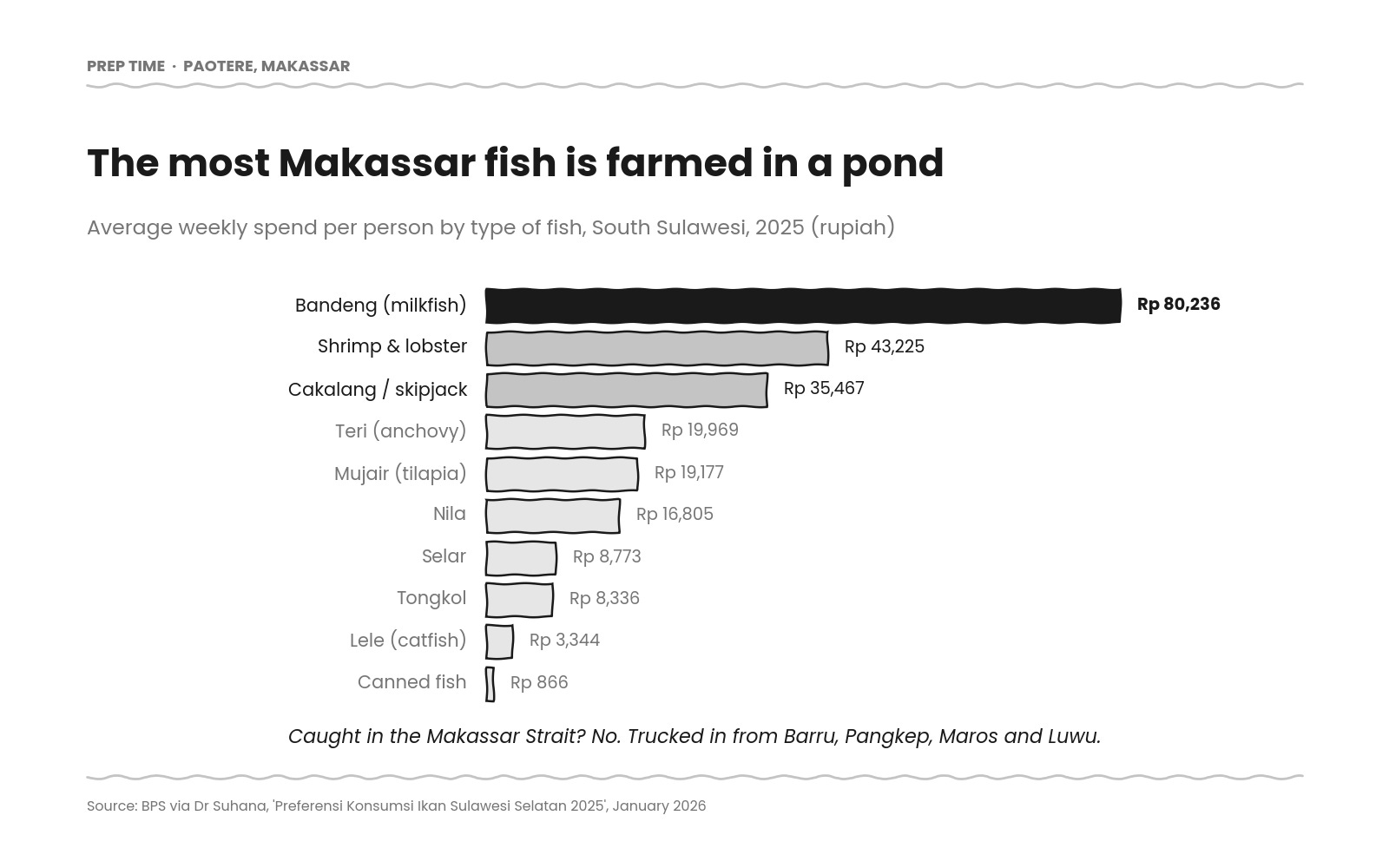
Which is the plot twist of this entire piece, because bandeng isn’t caught in the strait at all. It’s farmed in brackish ponds and trucked in. A Paotere trader told Kompas the bandeng there comes from Barru, Pangkep, Maros and Luwu Raya, inland and up the coast, by road.
And here’s the number that made me sit up. Fisheries economist Dr Suhana, reading 2025 BPS household data, found that the single largest weekly per capita spend on fish in South Sulawesi is bandeng, at Rp80,236. Shrimp and lobster second at Rp43,225. Cakalang third at Rp35,467.
South Sulawesi is a maritime province with a legendary seafaring history that spends more of its fish money on a pond fish than on anything that swims in open water. The province eats about 66.81 kilos of fish per person per year against a national average of 58.76, and the thing it reaches for most is farmed.
Suhana’s read on why is lovely. He argues people here don’t treat fish as cheap protein, they treat it as something with taste, prestige and tradition attached. Fresh sea fish is what you serve a guest.
Which is exactly what Bahtiar was doing. I met him walking out with a heavy bag and asked what he’d bought. Ikan cepak putih. Ten of them. Friends were flying in from Jakarta and Lampung that same day and wanting ikan bakar and kapurung, the sago dish, the Sulawesi cousin of papeda. He was going to do the fish in kuah asam, sour broth. He was hunting at the fish auction at 7 in the morning because people he loves were coming over.
Then he told me the price, and this is where the article turns.
Indonesia’s seafood export gap: where the money actually goes
Bahtiar paid Rp200,000 rupiah for ten fish. Rp20,000 each. And he said, unprompted, that in a restaurant one of those fish would probably run you Rp25,000.
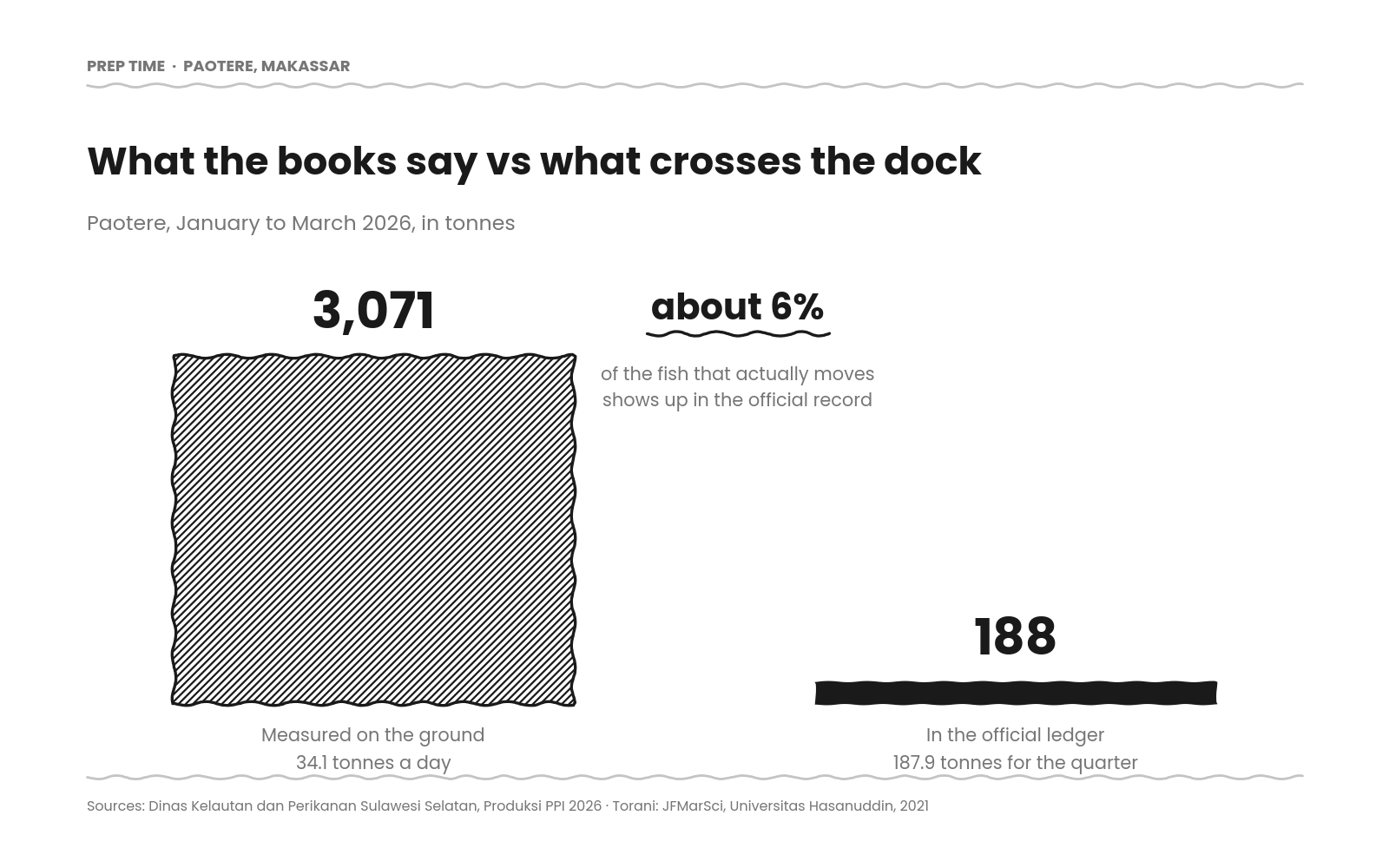
Layer one, the domestic gap. Officially, Paotere landed 187.9 tons in the first quarter of 2026, worth just under 8 billion rupiah, which works out to about Rp42,000 a kilo at the dock. Meanwhile the Hasanuddin team physically measured 34.127 tons crossing that dock PER DAY. 34 tons a day across a quarter is roughly 3.000 tons. The official ledger says 188. That’s about 6%. I can’t tell you where the rest goes, and neither could any source I found, which is its own kind of answer.
The market is also legally classified as a Type D port, meaning it’s built and permitted for an average of about 2 tons a day. It’s doing 34. Its own ice plant makes 500 blocks a day and it isn’t close to enough, so people buy ice from outside. The clean water tower is broken, so traders draw from a borehole about 100 metres deep and the big boats buy water outside the port in jerrycans on carts.
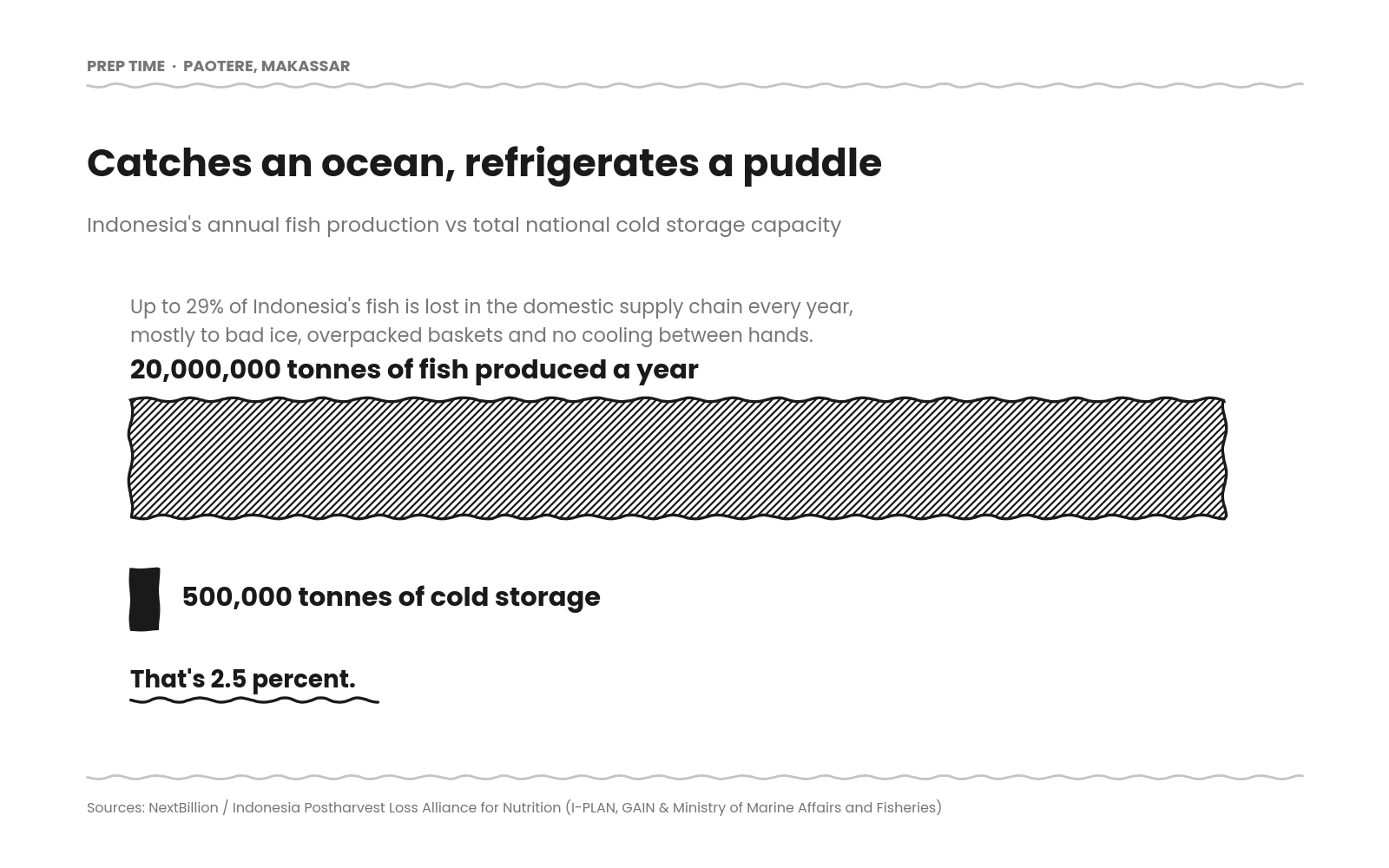
Now zoom out, because that’s not a Makassar problem. Up to 29% of Indonesia’s fish is lost in the domestic supply chain every year, mostly to bad ice, overpacked baskets and no cooling between hands. National cold storage capacity sits around 500,000 tons against roughly 20 million tons of fish produced annually. That is the entire opportunity in one sentence. A country that catches an ocean and refrigerates a puddle.
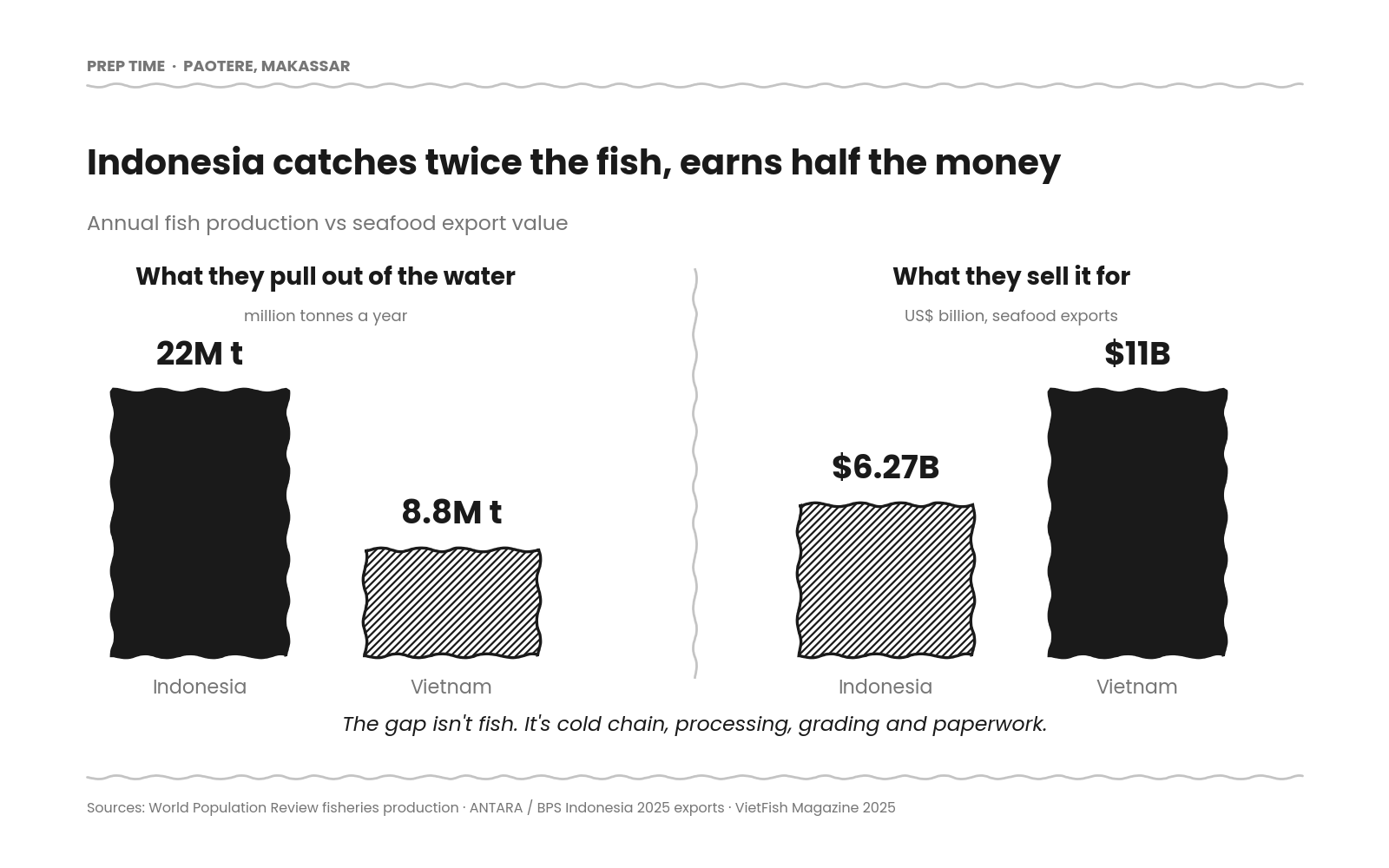
Layer two, the export picture. Indonesia is the second largest fish producer on earth by volume, around 22 million tonnes. Its seafood exports in 2025 came to US$6.27 billion, up 5.2%, with the US the biggest buyer at 1.99 billion, overwhelmingly shrimp.
Vietnam, on roughly 8.8 million tonnes, exported over 11 billion dollars.
Read that again. Vietnam catches under half of what Indonesia catches and sells it for nearly double. That gap is not fish. That gap is cold chain, processing, grading, traceability and paperwork. It’s everything that happens to a fish AFTER it stops being a fish and starts being a product.
South Sulawesi specifically sent 355,431 tons of commodities to 63 countries in 2025, around 11.1 trillion rupiah, of which fisheries were roughly 7.1 trillion. Biggest single earner? Seaweed, at 2.3 trillion. Top destinations China, Vietnam, South Korea, Japan and the Philippines. The province’s number one marine export is something almost nobody in Makassar sits down to eat.
Layer three, Paotere is not just a supply chain. It’s a room. It has boats, noise, a metre of barracuda on wet concrete, and men who’ve been awake since ten last night. People pay real money to stand in rooms like that.
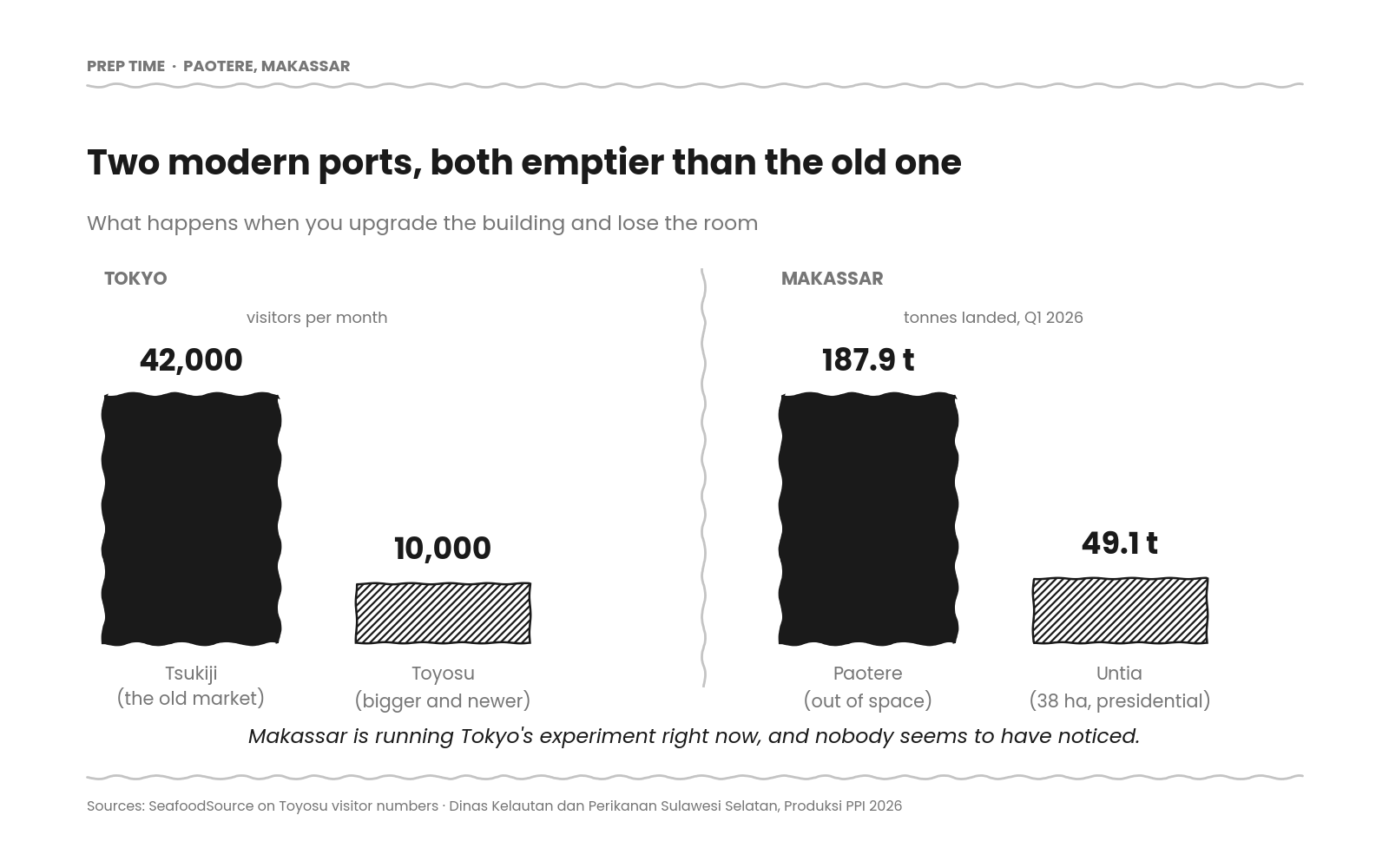
Tokyo has already run this experiment for us. The old Tsukiji inner market pulled roughly 42,000 visitors a month. Then it moved into Toyosu, a bigger, cleaner, more modern facility, the largest fish market in the world. Visitors dropped to around 10,000 a month and Tokyo has been building shopping complexes and hotels next door trying to win them back.
They upgraded the building and lost the thing people came for.
Makassar is running the exact same experiment right now and I don’t think enough people have noticed. Since 2005 Indonesia has been building PPN Untia, a 38-hectare national-class fishing port on the edge of the city, presidentially inaugurated, meant to take the industry and the auction that Paotere physically cannot hold. Local press spent years describing it as somewhere people go fishing for fun and couples go to be alone.
In the first quarter of 2026, Untia landed 49.1 tons. Paotere, the crowded one that ran out of space over a decade ago, landed 187.9.
Nearly four times, on a fraction of the land, with a broken water tower.
So should Makassar modernise Paotere, or leave it alone?
The opportunity in Makassar is not more port. It’s everything in the gap between the boat and the buyer. Ice that actually works. Cold trucks. Small-scale processing so a fish leaves the province worth more than it was worth at 5am. Financing that competes with the punggawa instead of pretending he doesn’t exist, because he’s the only one lending at 11 o’clock at night and until someone else does, he sets the price. Traceability, which is boring and unsexy and is the literal difference between 6 billion dollars and 11.
And underneath all of it, a market that’s already one of the most alive rooms I’ve walked into this year, that nobody is really treating like the asset it is.
But I’ll be honest about the tension, because I don’t think it resolves cleanly. Every single fix on that list makes the chain more formal. And the informality is not just inefficiency, it’s also Samsul deciding on the spot which fish go to the restaurant and which go to the auntie in front of him. It’s Bahtiar getting ten fish for Rp200,000 because he showed up early and knows what he’s looking at. Modernise it badly and you get Toyosu. A better building that fewer people love.
I asked Samsul, at the end, if there was anything he wanted to say. He’d been awake since before eleven the previous night. He said “pokoknya semua sukses, bahagia selalu,” basically, may everyone succeed and always be happy. And when I asked who all the work was for, he said his family.
So my question for you, and I actually want to hear it. If you were building something in that gap, would you formalise Paotere or would you fund the people already in it and leave the room alone?
Thanks for reading Prep Time. If you’ve got a market in your city that runs on a schedule nobody sees, tell me about it.