

This guide is for anyone trying to decide where to live in Bali. In short: families tend to settle in Sanur, newcomers who want friends fast in Canggu, walkers in Seminyak, ocean people in Uluwatu and Jimbaran, nature lovers in Ubud, and slow livers in the north and east.
We take no payment from landlords, agents, schools or gyms. The rent figures are our own count of public listings, not an agent’s estimate, and every price was checked in September 2026. The opinions come from living here, and from people I know who have lived in these areas.
In this guide
How much does it cost to live in Bali per month?
Rent is the big number, and the lifestyle adds more than you expect. A 2-bedroom house in Canggu asks a median of Rp15 million a month, about USD 840. In Pererenan it is Rp24.6 million, and in Jimbaran it is Rp7.4 million.
We had to count those ourselves. Nobody publishes a neutral rent number by area in Bali, and almost every rent table you will find in English comes from a property agent or a villa company. So on 24 September 2026 we pulled up to 100 house rental listings per area from Rumah123, Indonesia’s biggest property portal, removed the duplicates, turned yearly prices into monthly ones and took the middle price for 2-bedroom houses. These are asking prices, not what people end up paying, and they mix furnished villas with ordinary local houses.
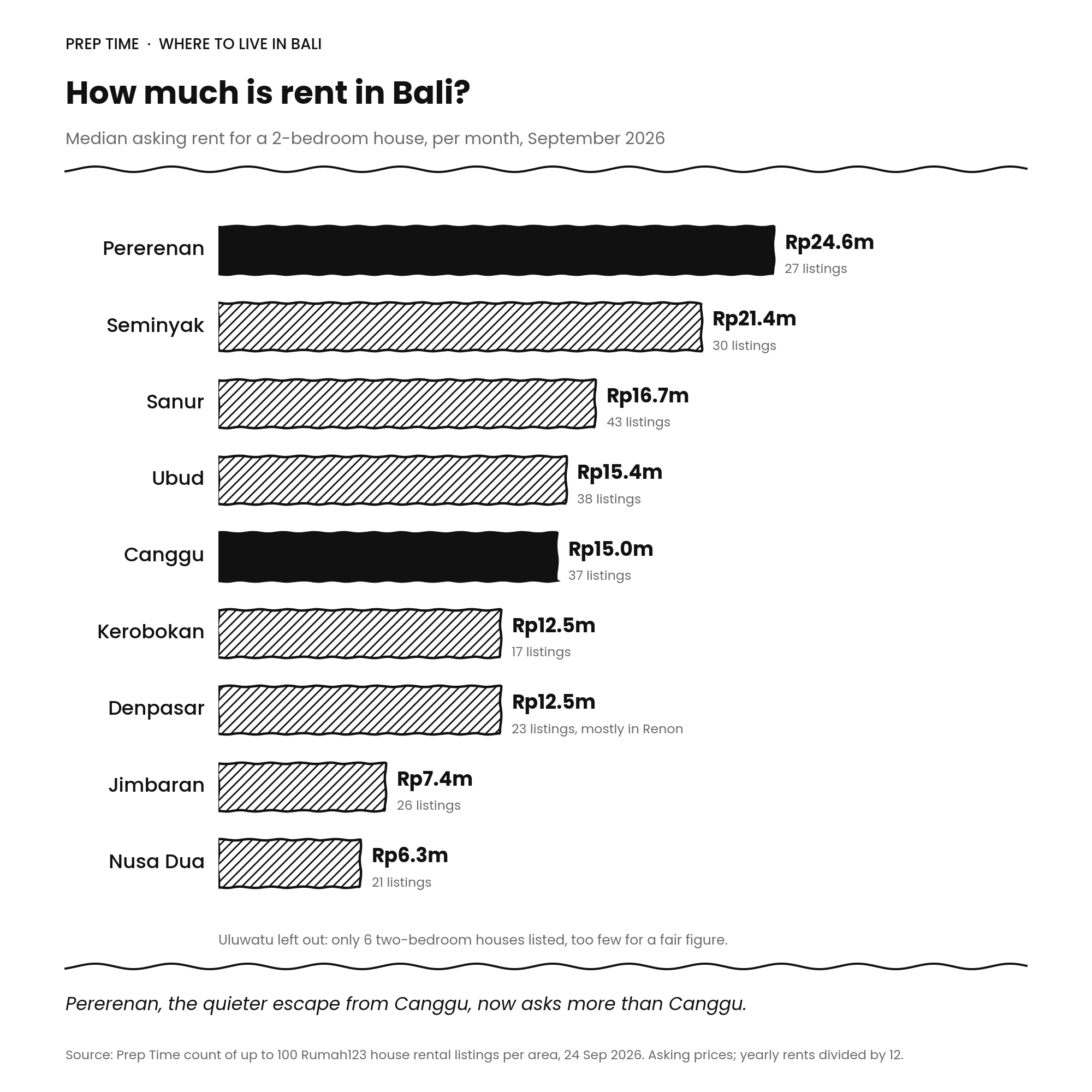
Pererenan surprised us most. It now costs more than Canggu to live there because its listings are mostly brand new villas. Jimbaran and Nusa Dua look cheap because most of what is listed there is ordinary housing for people who work in the hotels and at the university. Uluwatu barely shows up at all, 21 listings in total, because the clifftop villas rent through agents and Airbnb, not through local housing websites.
The thing that shocks people most is not the price. It is that long-term rent in Bali is usually paid a year up front. 76 of the 85 Canggu listings we counted were priced per year. Ubud is the exception, with more listings by the month than anywhere else, which is perfect for people to start there.
Then there is the lifestyle, and this is where Canggu really costs you. A month at Obsidian gym in Pererenan is Rp2,799,000 and a month of unlimited coworking at BWork in Canggu is Rp3,850,000. That is about Rp6.6 million before your morning coffees. In Sanur, a local gym and a coworking month can come to under Rp3 million. If you have children, school is the biggest line of all, from about Rp6 million to Rp28 million a month per child at the international schools in this guide.
Where do expats live in Bali? Everywhere now, but each area attracts a different kind
Canggu, Uluwatu, Ubud and Sanur are the areas people search most when they plan a move, according to our search data. From living here, I think the better question is which kind of expat lives where.
Pererenan and Seseh are for the glamorous ones, people who pay rent close to what they paid in their home countries and do not mind spending the same on lifestyle, as long as it feels like luxury. Canggu is for people who have just arrived and want friends quickly. Seminyak mixes foreigners with a lot more locals, and beaches for long walks. Uluwatu is for surfers and beach people, Ubud for nature and yoga, and Sanur for families.
One thing we can say about the north part: when immigration in Singaraja widened its checks to rental houses in July 2026, it named Lovina and Amed as areas with a high concentration of foreigners.
Where do locals live in Bali? All over the island, and often in rooms that cost a fraction of a villa
For Indonesians who move to Bali for work, the usual first home is a kos, a single rented room with a bathroom. A basic unfurnished kos in Denpasar rents for Rp600,000 to Rp900,000 a month, according to detikBali. A kos with a pool in Jimbaran, aimed at foreigners, rents for Rp3.3 million to Rp3.7 million.
The minimum wage in Badung, the regency that includes Canggu and Uluwatu, is Rp3,791,003 a month in 2026 (ANTARA Bali). A 2-bedroom house in Canggu asks about 4 times that, every month.
Local life is easiest to see in Denpasar, especially in Renon. You will also find more Indonesian neighbours in Jimbaran, Sanur and Seminyak than in Canggu or Pererenan.
Best area to live in Bali for families: Sanur and Denpasar, then Ubud or Canggu depending on the school
Sanur and Denpasar are where a lot of families settle. There are more international schools to choose from, supermarkets that locals actually shop in, and wide roads. Bali Island School in Sanur teaches from preschool to grade 12, and fees run from Rp76.9 million to Rp330.3 million a year (fee schedule). A 3-bedroom house in Sanur costs Rp20.8 million a month, less than one in Canggu or Pererenan.
Ubud has the widest spread of school prices. Pelangi School in Mas charges Rp86.5 million a year for primary (fee schedule), while Green School charges Rp240.4 million for the same years (fee schedule). Canggu Community School runs from Rp117 million to Rp272 million (fees).
Best area to live in Bali for digital nomads: Canggu for a base, Ubud for a month
For remote workers who want people around them, Canggu is the easiest place to start. There are so many coworking spaces, full of people building things, and people work from the cafes too. Between the events and the coworking, you will not struggle to make friends.
Ubud is the other common choice, especially for a month or two. It has the most monthly rentals, coworking from Rp130,000 a day according to Honeycombers, and it is, we think, the most walkable place in Bali.
Canggu vs Uluwatu vs Ubud: which is better to live in? Canggu for friends, Uluwatu for the ocean, Ubud for nature
These three could not feel more different, and where they are alike is the traffic. Canggu and Ubud both have small roads carrying far more traffic than they were built for, and Uluwatu has one big main road, winding and hilly, that you share with trucks.. carrying water.. sand.. and rocks..
On price, a 2-bedroom in Canggu costs about Rp15 million a month and one in Ubud Rp15.4 million. Uluwatu is harder to pin down because so few houses are listed publicly, so renting there usually means going through an agent.
For the beach, Canggu has black sand and beach breaks, and Uluwatu has white sand, clear blue water and reef breaks under the cliffs. Ubud has no beach at all, which is the one thing even people we knew, who love the area, wish were different.
Google Maps is not much help on distance either. Someone I know moved to Bali and went straight to Canggu, because that is where everyone recommends. The map showed a few kilometres from the airport, but it took him an hour and a half to get there, cause of the traffic lol.
Living in Canggu, Pererenan and Seseh
Where it’s most social, busy and expensive, with a few rice fields still hanging on in Pererenan and Seseh.
Canggu is where most people choose first, because it is where everyone recommends. Pererenan and Seseh, just to the west, are where the glamorous expats live now, in the beautiful new villas.
Pros: Canggu is the easiest place in Bali to make friends. If it is your first time here and you are on your own, you will find other solo travellers quickly. There is an abundance of everything: events, cafes, coworking spaces full of people building things, places to live, things to do at night. It is a very high-energy place. Pererenan and Seseh have the most glamorous gyms on the island, like Obsidian and Rite, the newest villas, and you still see a little bit of rice field, a little bit of nature.
Cons: To live in long term, we think it is chaotic. The area now holds far more people than its roads were built for, and the main road is small, just one route going everywhere. A car is hopeless for daily life, and it is not very walkable either, so you sit in traffic in the sun, breathing the fumes of the bikes in front of you, to reach somewhere 20 minutes away on foot. Some streets flood in rainy season. So many people are only passing through that it can feel transient. Someone I know loved it for a month, then moved to Seminyak.
Pererenan is the most expensive area in our count, Rp24.6 million a month for a 2-bedroom house, more than Canggu itself, and for that price some people feel cut off from Bali and Indonesia, living inside a culture of its own. There is construction everywhere, and nobody knows when Pererenan and Seseh will simply become Canggu. And sometimes the water in Pererenan smells bad when you shower or flush.. I do not know why. What I do know is that in September 2026 Badung’s regional secretary named Canggu and Pererenan, along with Pecatu and Ungasan, as villages short of water in the long dry season (Bali Post).
Living in Seminyak and Kerobokan
The older, walkable heart of South Bali, with a beach you can walk for kilometres for a date.
Seminyak and Kerobokan were the original Canggu of Bali. Some of the cafes and restaurants here have been open for 10-15 years.
Pros: It is the centre of South Bali life, and Canggu, Uluwatu and Denpasar are all easy to reach from here. The roads are so much better, because Seminyak and Kuta grew with plenty of big roads. If one route is jammed you take another, and being close to Sunset Road makes a huge difference. And the beach. From Double Six to Seminyak, Petitenget and up towards Berawa, it is one long, wide beach where you can walk for kilometres, or from the top of Seminyak down to Beachwalk in Kuta, an hour to an hour and a half each way. The sand is white compared to Canggu’s black, the sunsets are beautiful, and in the evening there are restaurants on the sand with music playing. There are actual sidewalks and many more locals, so it feels like living inside Indonesia, with plenty of foreigners around too. It is tidier than Kuta, and the cafes are as good as Canggu’s.
Cons: Seminyak itself is not cheap. A 2-bedroom house asks Rp21.4 million a month, though Kerobokan, right next door, asks Rp12.5 million. There is still traffic here, just much less of it.
Living in Uluwatu, Jimbaran and Nusa Dua
Where we think the best beaches in the south are.
Uluwatu is probably my favourite area in all of South Bali (Nadila speaking here). But when I first came here, I chose to live in Jimbaran. If you compare them, Uluwatu is the Canggu and Pererenan of the Bukit, and Jimbaran is its Seminyak and Kerobokan.
Pros: Uluwatu has the best beaches: white sand, crystal blue water, and limestone hills everywhere that make it feel luxurious. You can have a date dinner on top of a cliff looking out over the sea at sunset. It is great for surfing, and there is a real tanning-at-the-beach culture. Dreamland Beach feels a bit like Australia, with people sunbathing and playing volleyball on the sand. And it is not as trashy as Canggu, I think.
Jimbaran has more Indonesians living in it, and the rent makes sense: Rp7.4 million a month for a 2-bedroom house, the second cheapest in this guide. It is easier to live from, too. The toll road takes you to Nusa Dua and Sanur, and Kuta and Seminyak are much closer. Nusa Dua, which I do not know well, has calmer beaches for water sports, and it is where most of the sea and beach events on the island seem to happen.
Cons: Uluwatu has one big main road, winding and hilly, that you share with trucks, and a lot of traffic on it. The expensive life is concentrated down in Uluwatu and Pecatu, and so few houses there are listed publicly, 21 in our count, that you will likely rent through an agent. Then there is water. Villages here have long bought water from tanker trucks, and Ungasan residents pay about Rp60,000 per cubic metre for it (Bali Post).
Living in Ubud
Jungle, rice fields and beautiful houses, but a long way from the beach.
Ubud sits further north and higher up than the rest of South Bali, and it is hillier.
Pros: It feels more like raw, nature-filled Bali. There are waterfalls and jungle, and in some places you wake up and there are monkeys outside. The centre is the most walkable place in Bali, with little cafes, shops and alleyways to explore on foot, and plenty of yoga and meditation centres. There are a lot of good cafes, so you get nature and a bit of town. And the houses. The architecture feels like a cabin, with lots of windows and so much light.
For the quality, the design and the artsiness you get, I think Ubud and the rest of Gianyar are the best rent-to-value on the island. On paper a 2-bedroom asks about the same as in Canggu, Rp15.4 million against Rp15 million, but the listings cannot show you what you get for it. Go 10 or 15 minutes outside the centre and there are rice fields, gardens and big houses with room to breathe. Ubud also has more monthly rentals than anywhere else.
Cons: There is no beach. The traffic, I think, is the worst in Bali, like Canggu but worse, and a car is hopeless there. And the spirituality. If you want a palm reader, a shaman or an energy cleansing, Ubud is where people go. Maybe it used to be Balinese spirituality. Now a lot of it is fusion, and some of it is gimmicky: chakra sprays, aura perfumes. The rainy season may also be gloomier up here than on the coast.
Living in Sanur and Denpasar
Family life, sunrise beaches, and the Balinese city at its warmest.
I have not lived in Sanur myself, so I will not pretend to know it street by street. But I love Renon, in Denpasar.
Pros: This is where a lot of families build their life in South Bali. There are more international schools and more choice, more locals living around you, and supermarkets made for locals rather than tourists. Sanur had 529 house listings when we counted, more than Canggu, and a 3-bedroom house asks less there than in Canggu. Denpasar’s 2-bedroom figure, Rp12.5 million, is pulled up by the smart streets of Renon, and most of the city rents for far less.
In Denpasar the roads are big, and when I drive through it I feel like I am in Jakarta. Anything you want, you can find there, and it is not overpriced. And there is Renon. Every Sunday morning there is car-free day around the park, and it gets so lively. People walk, there is a flea market, teenagers hang out, couples go on dates, families come together, and sometimes there is a concert happening in the park. Any day around sunset, there are families on the grass having picnics and eating street food. It is such a warm place to be.
Cons: Sanur’s beach faces east, so it is a sunrise beach, not a sunset one. And parts of Denpasar flood: 10 of the 16 people who died in Bali’s September 2025 floods were in Denpasar (CNN Indonesia).
Living in north and east Bali: Amed, Lovina and Sidemen
The village side of Bali, for slow living.
Pros: Amed, Lovina and Sidemen are still the village side of Bali. Most of it still feels untouched, with locals just doing their thing, and the nature is amazing. It is a way to live off-grid, quote unquote, inside real Balinese culture with Balinese neighbours, and to live slowly.
Cons: If you need a coworking space, great espressos, and a gym in your daily routine, I do not think it is for you.
Very few people search for these places as somewhere to live. Search data shows almost nothing for Amed and Lovina, and zero searches for living in Sidemen. But people are moving there anyway. Immigration counts Lovina and Amed among its high-concentration areas for foreigners, and Karangasem lost 440 hectares of rice fields to houses and villas between 2021 and 2025, most of them in Sidemen, according to the regency’s agriculture office (detikBali).
If you only read one thing
The best area to live in Bali depends on how you spend a normal Tuesday. Families with school-age children tend to end up in Sanur, because it has more international schools to choose from, including Bali Island School, which runs all the way to grade 12, and rent is lower than Canggu for a bigger house. Remote workers who want coworking, gyms and people around them usually start in Canggu, or in Ubud for a month or two. Surfers and anyone who wants the cliffs gravitate to Uluwatu and live with the drive. When rent matters most, Jimbaran and Nusa Dua ask about half of what Canggu does for a 2-bedroom house, and Kerobokan is cheaper than its neighbours.
Two more, from living here. Seminyak is where you can walk everywhere and feel like you live in Indonesia rather than next to it. And for people who do not need a gym or a coworking desk and want a slower life among Balinese neighbours, there is Amed, in the east.
Where to live in Bali Frequently Asked Questions
Where is the best place to live in Bali?
The best place to live in Bali depends on your life. Sanur suits families, Canggu suits people who want to make friends fast, Seminyak suits walkers, Uluwatu and Jimbaran suit ocean lovers, Ubud suits nature lovers, and Amed suits slow living.
How much does it cost to live in Bali per month?
Rent for a 2-bedroom house in Bali costs about Rp15 million to Rp25 million a month in Canggu, Pererenan, Seminyak, Ubud and Sanur, and about Rp6 million to Rp7.5 million in Jimbaran and Nusa Dua. Most long-term leases are paid a year up front.
What is the cheapest area to live in Bali?
Nusa Dua and Jimbaran are the cheapest areas in this guide, with 2-bedroom houses asking about Rp6.3 million and Rp7.4 million a month. Kerobokan, next to Seminyak and Canggu, asks about Rp12.5 million.
Is Canggu a good place to live?
Canggu is a good place to live for a short time, especially if you are new to Bali and want to make friends. For the long term, its traffic and small roads make daily life hard.
What is the best area in Bali for families?
Sanur and Denpasar are the best areas in Bali for families, because they have the most international schools, including Bali Island School up to grade 12, and 3-bedroom houses cost less than in Canggu.
Is Ubud a good place to live?
Ubud is a good place to live if you love nature and walking and can live without a beach. Its traffic is heavy, so get around on foot or by bike.
Do you have to pay rent a year in advance in Bali?
Most long-term rentals in Bali are paid a year in advance. Monthly rentals are easiest to find in Ubud.