

Bali restaurants buy their food from two supply chains. Bedugul farmers sell fresh vegetables to collectors and small suppliers. Those suppliers deliver to kitchens the next morning. Distributors in Denpasar supply meat, dairy, frozen and imported food. Much of that food arrives on the Gilimanuk ferry from Java. Sysco, the world’s largest food distributor, keeps 3.8% as operating profit. A 2018 Bali regulation requires restaurants to buy 30% local products.
Diners never see the chain between a Bedugul field and a Canggu plate. The clearest picture of it came when it broke. In March 2020 the hotels in Kuta and Sanur stopped ordering, and Wayan Mustika, a vegetable farmer in Baturiti, had a field full of crops grown for buyers who had vanished. He had been growing paprika, basil, Japanese cucumber, baby romaine and arugula, because that was what the hotels asked for. “Karena permintaan ke hotel jadi yang kami tanam yang sesuai permintaan dan standar hotel,” he told IDN Times Bali. We planted to hotel demand and hotel standard. That March they cut the crop down and fed it to the cows.
A Baturiti farmer planting arugula to a Kuta hotel’s standard is the whole story in one field. The kitchen decides what grows on the mountain, and between the two is a layer of people nobody writes about. People are searching for it anyway. Type “where do restaurants buy their food” or “how do food distributors make money” into Google and it finishes the sentence for you. Here is the answer for this island.
Where do restaurants buy their food in Bali? From Bedugul farmers and Denpasar food distributors
The first chain carries anything fresh and green. It starts in the highland belt around Candikuning and Baturiti in Tabanan, which people shorthand as Bedugul. Farmers sell to pengepul, collectors who buy at the field. Collectors sell to small suppliers, usually registered as a CV or UD, who grade the produce and deliver to kitchens in the south. Sometimes the collector sells to the hotel directly. Between the two there is a wholesale vegetable market, Pasar Induk Sayur Mayur in Banjar Baturiti Kaja, which the governor said in 2022 he would hand to the desa adat because it was underperforming. I could not find out whether that happened, or what the market looks like before dawn.. (sounds like I need to do some more field research!)
This chain is fast. A team at Universitas Udayana measured the vegetable supply from Bedugul farmers to Bali hotels across cabbage, carrot, caisim, broccoli and white mustard. Lead time from order to delivery was 0.67 days, and 98.2% of orders arrived complete, on time and to spec. The researchers graded it superior. What you order at dinner is picked, bought, sorted and trucked down the mountain before lunch the next day.
The second chain carries everything cold, dry or imported. Beef, cheese, butter, frozen fries, flour, cooking oil and salmon come through distributors based mostly in Denpasar, and much of it starts outside Bali. The US agriculture department’s attaché in Jakarta writes that Indonesia’s food service sector relies on imports for beef because of constant domestic shortages, with Australia supplying beef and dairy and New Zealand supplying cheese.
Some of it is less obvious. The garlic in your sambal is very likely Chinese, because 90% to 95% of Indonesia’s garlic is imported, mainly from China, according to Nawandaru Dwi Putra of the trade ministry in January 2026. Governor Wayan Koster admits Bali’s own garlic loses on price and clove size, and offered a tasting note while he was at it: “yang bawang putih China hambar. Kalau bawang putih Bali nyengat.” Chinese garlic is bland, Bali garlic bites. Eggs and frozen chicken for the government’s free school meals (MBG) in Bali come from Banyuwangi in East Java because they are cheaper, per the provincial agriculture department. That is a public programme rather than a restaurant, and I have not confirmed that restaurant suppliers follow the same price gap, though nothing obvious would stop them.
Most of that crosses the Bali Strait by truck on the Ketapang to Gilimanuk ferry. After the KMP Tunu Pratama Jaya sank in July 2025 and cargo loads were capped, trucks queued 26 km back from Ketapang. This month, with dock repairs and trucker protests, the queue reached 15 km and drivers waited one to two days to cross. “Logistik menjadi urat nadi dari perekonomian,” said A.A. Bgs Bayu Joni Saputra, who chairs ALFI Bali, the logistics association, on 5 September. Logistics is the artery. I could not find a Bali restaurant or distributor on record saying a particular ingredient ran out because of the queue, so I will not tell you one did.
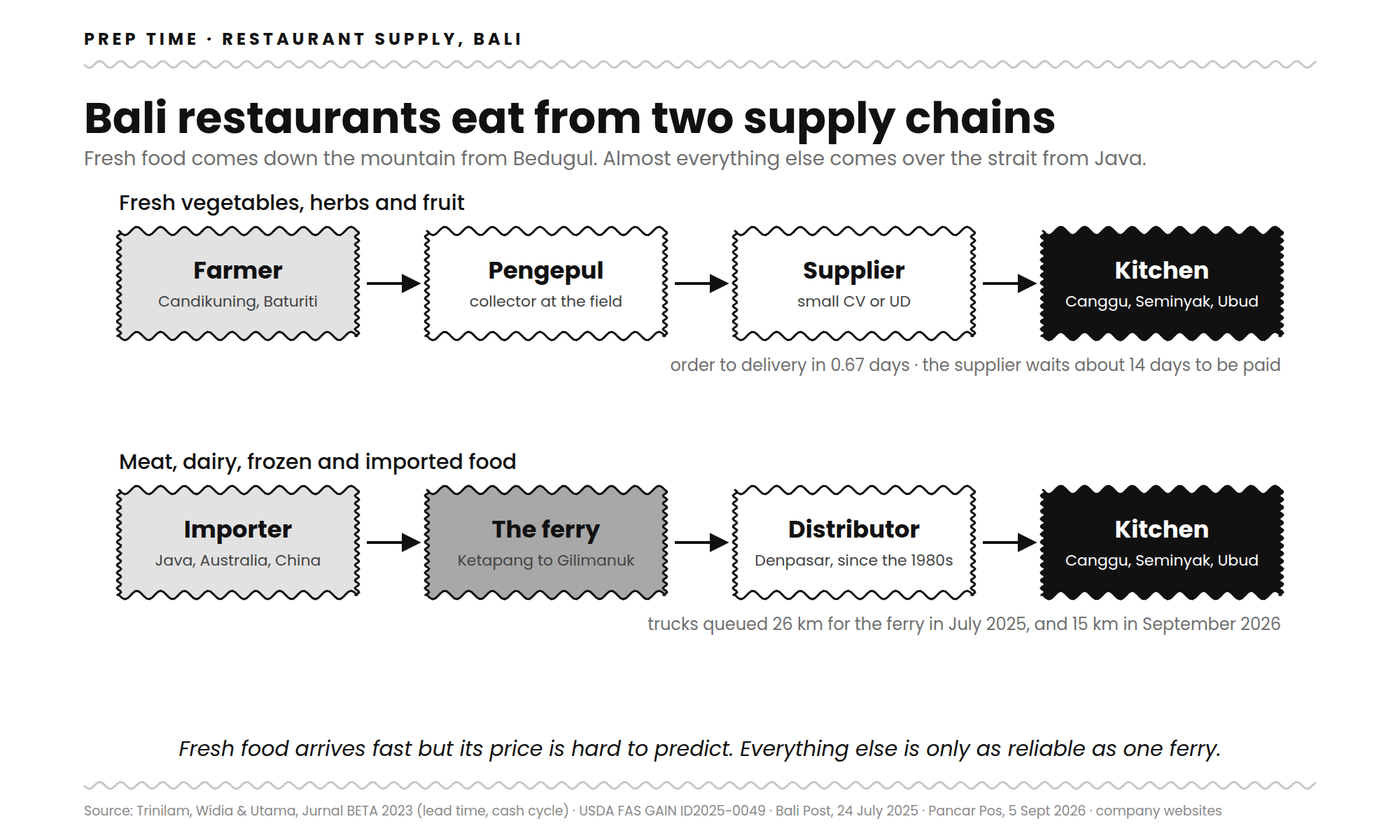
Who supplies restaurant food in Bali? Local vegetable suppliers and food distributors in Denpasar
The cold and dry side of Bali runs on a handful of distributors that were here long before Canggu became a restaurant district. Everything below comes from the companies describing themselves.. (they have less glamorous names)
PT Sukanda Djaya, the cold chain arm of Diamond Food Indonesia, opened its first branch outside Java in Denpasar in 1983, according to its Indonesian Wikipedia entry, which I would want to check against the company’s own history. PT Puri Pangan Utama in Denpasar was established in 1985, calls itself the pioneer of frozen food supply in Bali, and runs more than 25 refrigerated trucks to all nine regencies and across to Mataram. PT Alamboga Internusa started in 1990 with 8 people and 2 refrigerated trucks and now employs more than 120, importing from more than 20 countries. Cahaya Boga Utama says it carries more than 9,000 products with 24 hour delivery. Around them sits a long tail of meat, seafood and frozen specialists.
The fresh side is harder to name because it is mostly small operators, but it has at least one founding story. In 1993 Made Gunada, an economics graduate farming in Candikuning against his family’s wishes, took homegrown lemons to McDonald’s in Bali on a friend’s suggestion. He started at 40 kg a day. By 2020, NusaBali reported, he was supplying lettuce, tomatoes, carrots and pickles to McDonald’s, Burger King, Starbucks, A&W and others across Indonesia, with growing operations from Batu to Manado and 60 tonnes of pickles a month fermenting in Bedugul. That report is six years old and I have not reached him. It is still the best example I found of a farmer who stopped selling to the middle and became it.
How do food distributors make money? A small margin on big volume, plus credit to restaurants
The biggest foodservice distributor in the world is Sysco. In its 2025 financial year it sold US$81.4 billion of food to about 730,000 customer locations, with a gross margin of 18.4% and an operating margin of 3.8%. Put simply, of every US$100 a restaurant pays, about US$18 is markup over what Sysco paid, and after trucks, cold rooms, drivers and bad debts, under US$4 is left.
Indonesia looks similar. Diamond Food Indonesia, Sukanda Djaya’s parent and the one Bali relevant distributor with public accounts, reported a gross margin of 19.9% and an operating margin of 2.1% in the first quarter of 2025, according to an analysis of its filing. Diamond also makes its own products, so that is not a pure distribution number, and I took it from an analyst’s summary rather than the filing itself. The direction still holds. Big distribution is a volume game that keeps a few cents on the dollar and loses them fast when fuel or a ferry queue pushes costs up.
Lower down the markup looks fatter. Udayana researchers tracked strawberries from Baturiti in 2022. Farmers sold at Rp12,000 a kilo. On the route from farmer to collector to hotel or restaurant, the marketing margin was Rp13,000 a kilo, and the collector kept Rp8,875 of that after costs. If I add the margin to the farm price, the hotel paid about Rp25,000 and the farmer got a little under half. That last step is my arithmetic on the paper’s summary, not a figure the researchers printed. Across Bali more broadly, BPS measured the combined trade and transport margin on chicken eggs at 20.44% and on rice at 15.74% in 2020. Those are household chains, not restaurant ones, but they land almost exactly on Sysco’s number.
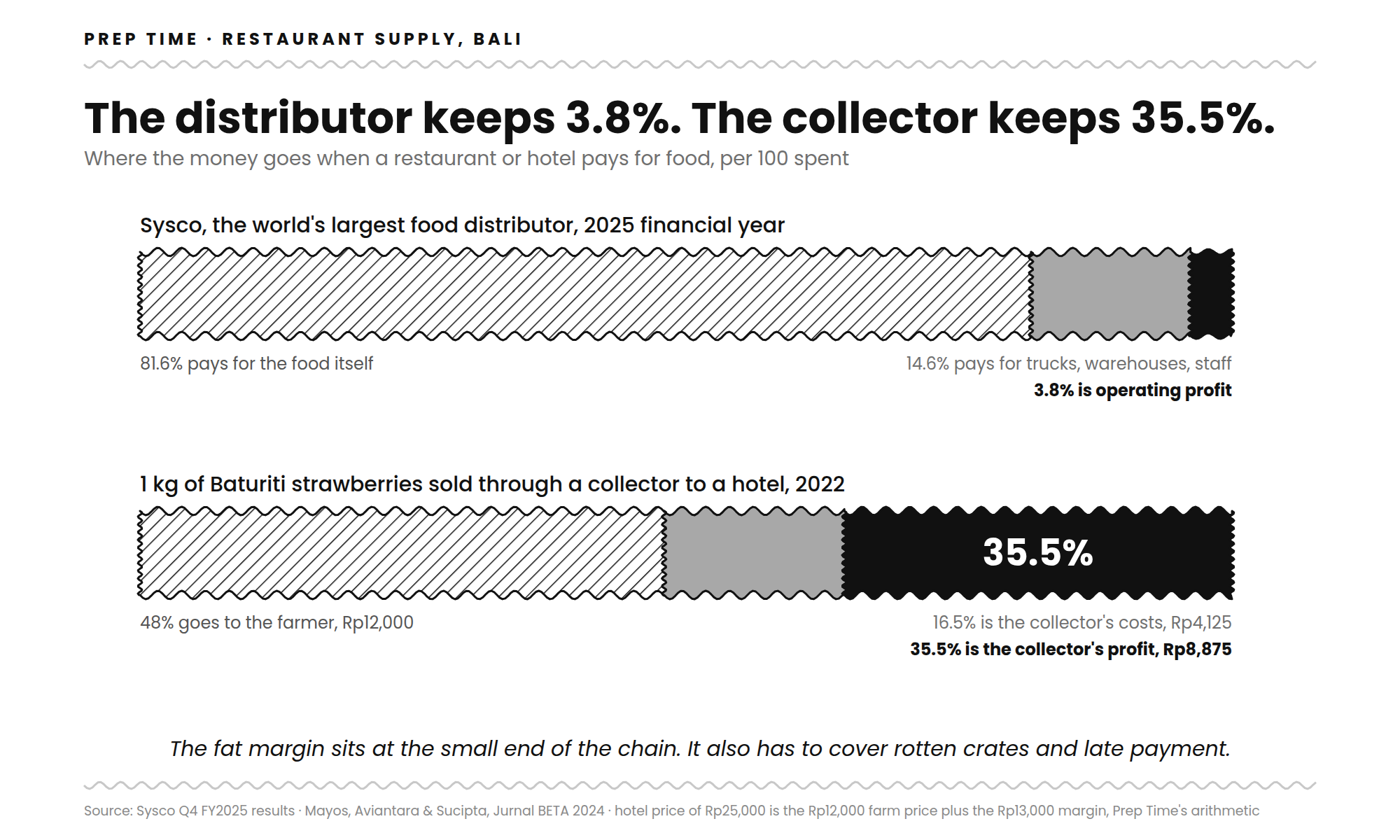
The part the margin hides is credit. Hotels and restaurants rarely pay on delivery. The Udayana hotel study measured a cash to cash cycle of 13.8 days, meaning someone waits about two weeks between paying for vegetables and being paid for them, and it is not the hotel. In 2019 Nengah Suarsana, a red rice farmer in Tabanan, told NusaBali that hotels and supermarkets ngebon, buy on tab, which strangles a farmer who has already paid for seed and labour. The collector steps into that gap with cash. Alvius A. Ahmad, a former bank analyst who now farms, wrote in Mojok that “margin bukan sekadar keuntungan bersih; ia adalah bantalan risiko.” Margin is not just profit, it is a risk cushion. It pays for rotten crates, empty trucks, harvest gluts and the buyer who pays late. That is how the small middle makes money. It is partly a vegetable business and partly a lending business.
People have tried to cut it out. TaniHub, the best funded Indonesian startup built to connect farmers directly with buyers, raised US$65.5 million in 2021 and then closed its warehouses in Bandung and Bali in February 2022. The company’s later troubles involved its lending arm and a criminal case over investor money, so its collapse is not proof that middlemen cannot be beaten. The Bali warehouse closing does show the shortcut was harder here than the pitch.
What buyers actually complain about is price, not supply. A 2025 survey of hotels, restaurants and cafés across Bali, Lombok and North Sulawesi, published in Frontiers in Sustainable Food Systems, found 93.2% had consistent access to supply and only 11% trusted prices to stay stable. A Bali restaurant owner told the researchers, “Even if I get the vegetables I need, I have no idea if next week the price will triple.” Only 32.4% bought directly from smallholder farmers.
How do restaurants find suppliers in Bali? Hotels run monthly supplier tenders
The most detailed look at a Bali hotel’s buying is a 2026 study of a five star property the researchers call Hotel A. Every day the kitchen builds a Daily Market List from occupancy, the menu, what is in stock and its food cost target. The Executive Chef signs it. Purchasing turns it into purchase orders. Suppliers deliver, and receiving checks quantity, quality, packaging, expiry dates and, for meat, temperature, before anything reaches the kitchen.
Hotel A works with about 96 food suppliers and picks them through a monthly tender that compares offers. The problems the researchers found will sound familiar to anyone running a kitchen: the chef signing off late and holding everything up, suppliers out of stock, prices moving, late trucks, and deliveries that do not match the order. The purchasing manager does not decide what the hotel eats. The chef does. Purchasing decides who supplies it and at what price, and it keeps several suppliers per category so one missing truck does not empty the cold room.
A standalone café in Canggu has none of that department, and the people trying to sell to it know where the friction is. I Made Suana, who chairs Koperasi Ngardi Rahayu, a cooperative helping small Bali producers into hotels, said in July that “tantangan terbesar kita sebenarnya ada pada kualitas dan kontinuitas”. The biggest challenge is quality and continuity, not financing. Gede Sedana, rector of Universitas Dwijendra, put the farming side of it plainly: off season the buyers want local produce and the farmers cannot grow it, and at harvest the reverse happens and prices crash.
Do Bali restaurants have to buy local produce? Yes, Pergub Bali 99/2018 requires 30%
Here is the part that changes the question. Peraturan Gubernur Bali Nomor 99 Tahun 2018 covers the marketing and use of local agricultural, fishery and industrial products, and Koster signed it on 28 December 2018. I read the text.
Pasal 13 requires hotels, restaurants and caterers to use at least 30% local food crops and horticulture, at least 30% local livestock products, at least 30% local fish, and at least 20% locally made industrial products. Pasal 16 says local farm produce must be bought at no less than 20% above production cost. Pasal 18 says buying direct from farmers must be paid in cash, and buying on credit must go through a provincially owned company instead. Pasal 1 defines local as grown or raised in Bali, so Australian beef from a Denpasar distributor does not count, and neither does a Banyuwangi egg bought from a Bali supplier. The sanction in Pasal 29 is “sanksi administratif” with no amount and no named inspector.
Read Pasal 18 again. It goes straight at ngebon. It tries to take the collector’s credit role away and hand it to a state company. Seven years on, I found no sign that any provincial company is carrying that credit at scale, and no record of a single hotel or restaurant being sanctioned.
The two sides do not agree on whether it matters. In 2019 Ida Bagus Purwa Sidemen, then executive director of PHRI Bali, told the Jakarta Post that “more than 90 percent of our needs are fulfilled by local products”, with imports limited to things like kiwi fruit. In February 2026 Koster said hotels need to be “lebih militan” about using Bali products. Both cannot be true under the regulation’s definition. My guess, and it is only a guess, is that the hotels count anything bought from a Bali supplier as local and the regulation counts only what was grown here.
It may get teeth. In August, Agung Bagus Pratiksa Linggih, who chairs the agriculture commission at DPRD Bali, said the council is drafting a perda to replace the governor’s rule, with tiered local buying quotas of 40% to 80% for hotels and restaurants, a regional food aggregator and an enforcement task force, aiming to finish by the end of 2026. That comes from one small outlet and I have not confirmed the percentages with the council. Separately, a Badung legislature committee is working on a regional bill that would require hotels, restaurants and supermarkets to source local products, with sanctions running from a verbal warning up to a recommendation to revoke the business licence. Badung is Canggu, Seminyak, Kuta and Uluwatu.
How can a Bali restaurant manage its food suppliers? 4 simple steps
A Bali restaurant should treat its suppliers as lenders, not only as delivery services. The reporting above points to four fixes, in order of how cheap they are.
1. Pay your fresh supplier on time.
The supplier who drops vegetables at 7 am and invoices at the end of the month is financing your food cost, and a collector behind them is doing the same for a farmer in Baturiti. The Udayana hotel study put that wait at about two weeks. Late payment is the thing the whole chain is built to absorb, and the 2018 regulation was written to stop it. Paying on time costs you nothing extra.
2. Write a par list and check every delivery against it.
Hotel A’s Daily Market List works at any size. A written list, even a short one, gives a supplier something to quote against and gives you something to check the crate against when it arrives. Receiving is the cheapest control in the kitchen. It does not need a purchasing manager. It needs someone whose job it is.
3. Keep a second distributor for anything that crosses the Bali Strait.
Imported and frozen goods come over on a ferry that queued for 15 km this month and 26 km last July. A second supplier for your core cold and dry items turns a stuck truck into an annoyance instead of a missing dish. Fresh produce has a different risk, which is price, because Bedugul prices move with hotel occupancy.
4. Ask your suppliers where each product is grown.
Pergub 99/2018 counts only food grown or raised in Bali as local, and a supplier’s address in Denpasar does not make its stock Balinese. If DPRD Bali passes the perda it is drafting, restaurants may have to prove a local share of 40% or more. Knowing the origin of your top 20 ingredients now is a spreadsheet, not a crisis.
Bali restaurants buy vegetables from local suppliers who buy from Bedugul farmers. Bali restaurants buy meat, dairy and imported food from distributors in Denpasar. If you run a restaurant in Bali, start with four easy habits this week. Pay your vegetable supplier on time. Use two suppliers for meat, dairy and imported food. Write down every order and check each delivery against it. Ask each supplier where the food was grown.
Frequently Asked Questions
Where do restaurants buy their food in Bali?
Bali restaurants buy through two chains. Fresh vegetables come from farmers in the Bedugul highlands, sold through collectors and small suppliers who grade and deliver to kitchens the next morning. Meat, dairy, frozen and imported food come from distributors based mostly in Denpasar, much of it arriving by ferry from Java.
Who supplies restaurant food in Bali?
The cold and dry side runs on a handful of long-established distributors in Denpasar, such as Sukanda Djaya, Puri Pangan Utama and Alamboga Internusa, some operating since the 1980s. The fresh side is mostly small local suppliers and collectors buying direct from Bedugul farmers, which makes them harder to name but central to how kitchens get their produce.
How do food distributors make money?
On a small margin over big volume, plus credit. Sysco, the world’s largest foodservice distributor, keeps about 3.8% of sales as operating profit. Distributors also lend to restaurants in effect, because kitchens rarely pay on delivery, so the margin doubles as a cushion for spoilage, empty trucks and late payment.
Do Bali restaurants have to buy local produce?
Yes, on paper. Governor’s Regulation 99/2018 requires hotels, restaurants and caterers to use at least 30% local food crops, 30% local livestock and fish, and 20% locally made goods, with local defined as grown or raised in Bali. Enforcement is weak, though, and the council is now drafting a stronger regulation with higher quotas.
How can a Bali restaurant manage its food suppliers?
Treat suppliers as lenders, not just delivery services. Pay your fresh supplier on time, write a par list and check every delivery against it, keep a second distributor for anything that crosses the Bali Strait by ferry, and ask each supplier where the food was actually grown so you know your real local share.